
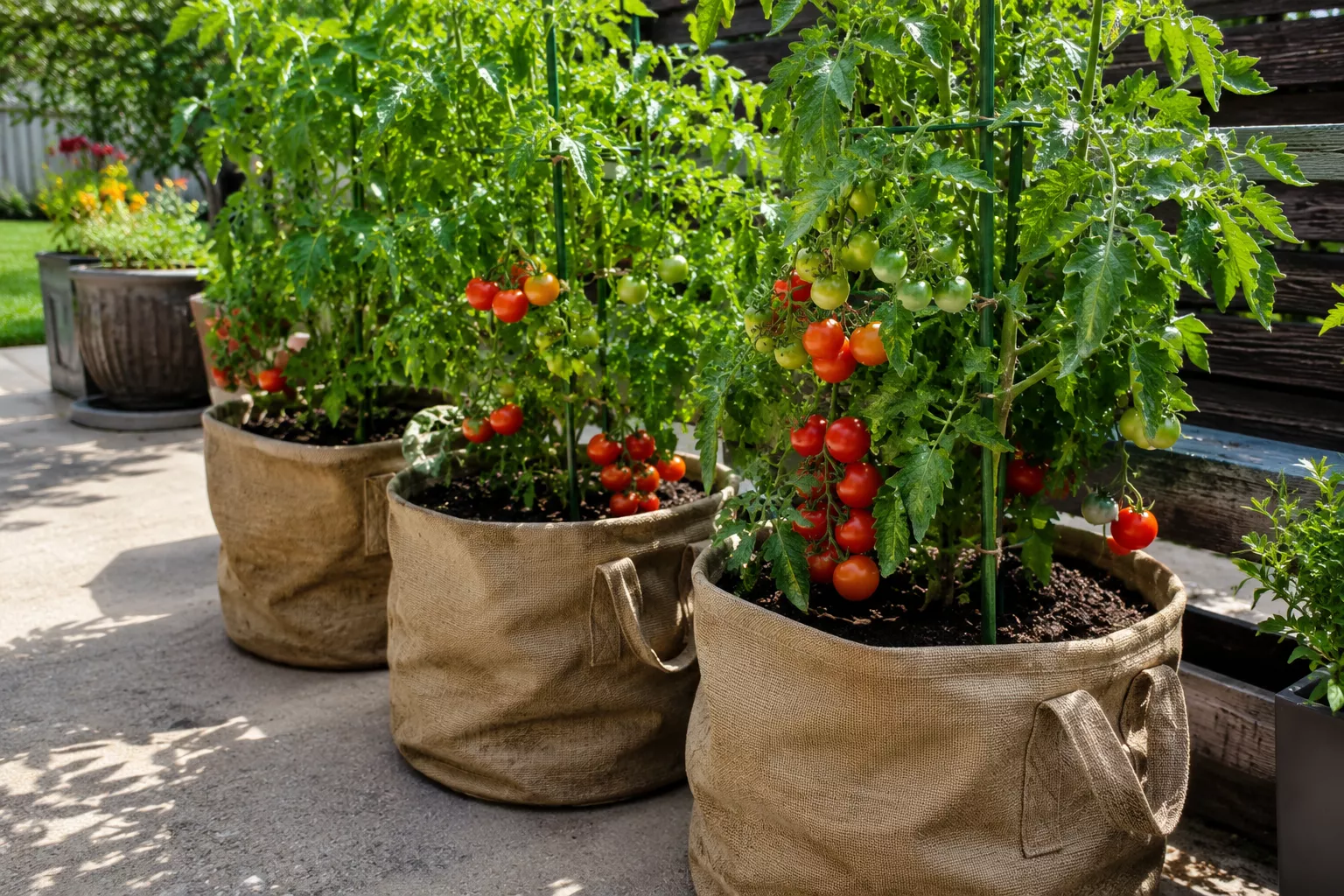
How to Grow Tomatoes in Grow Bags: The Complete Beginner's Guide
Growing tomatoes in grow bags is one of the simplest ways to grow fresh tomatoes at home, especially if you do not have much garden space.
You do not need a big vegetable patch. You do not need perfect soil. You do not even need a raised bed.
With a sunny patio, balcony, driveway, greenhouse, or small corner of the garden, you can grow healthy tomato plants in grow bags and enjoy a proper homegrown harvest.
Grow bags are especially useful because they are lightweight, easy to move, good for drainage, and brilliant for small-space growing. They also give tomato roots plenty of air, which can help the plant build a healthier root system.
But there is one important thing to know before you start:
Tomatoes in grow bags need more regular watering and feeding than tomatoes growing in the ground.
That is not difficult. It just means you need a simple routine.
In this guide, you will learn how to grow tomatoes in grow bags from start to finish, including the best grow bag size, the right potting mix, which tomato varieties to choose, how often to water, when to feed, how to support your plants, and how to avoid the most common grow bag tomato problems.
Why Grow Tomatoes in Grow Bags?
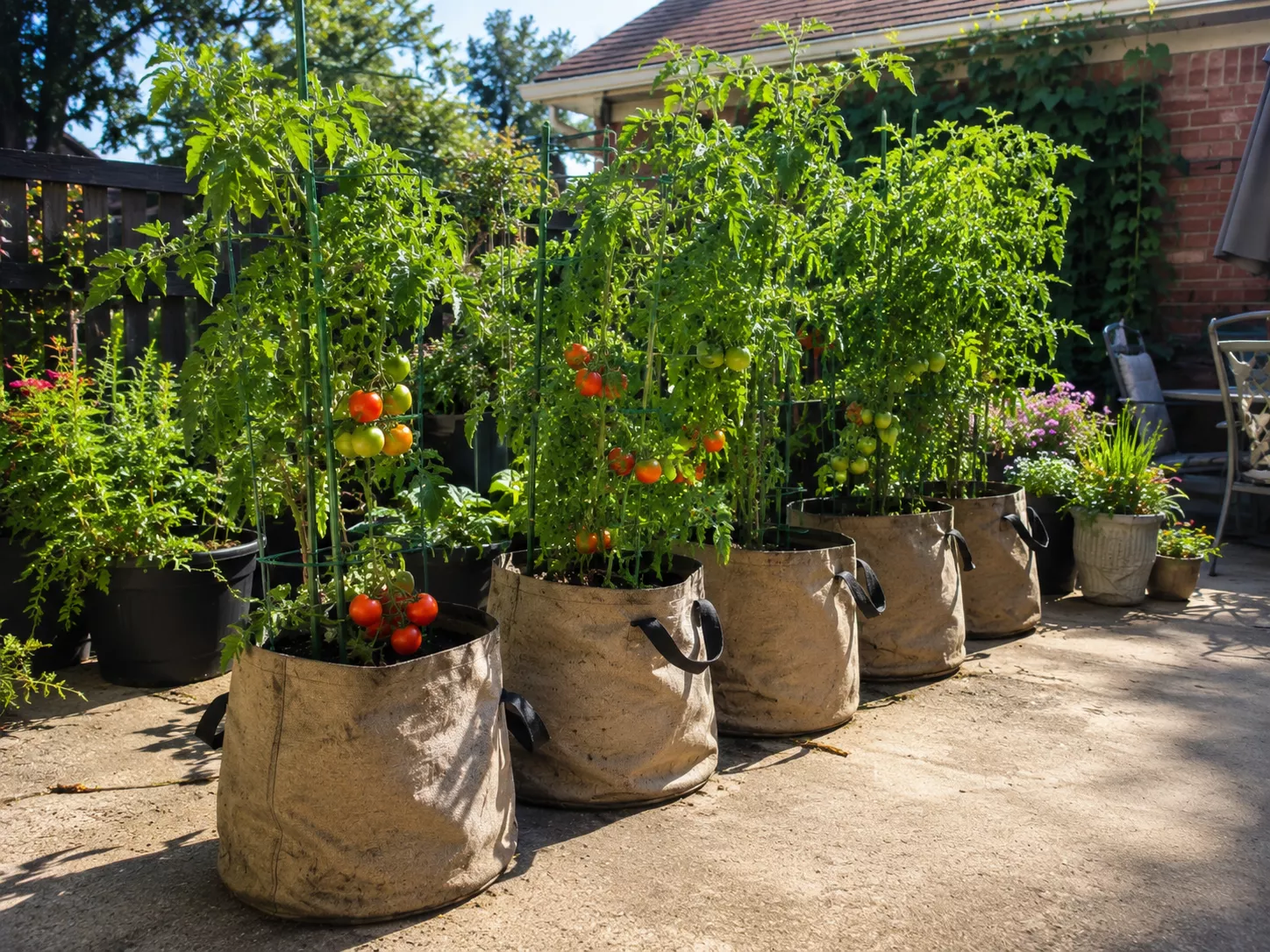
Grow bags are a simple way to grow tomatoes on patios, balconies, driveways, and small gardens.
Grow bags are popular because they make tomato growing more flexible.
Instead of digging into poor soil or building a permanent bed, you can fill a bag with good compost or potting mix and grow tomatoes almost anywhere with enough sunlight.
Grow bags are useful if:
- Your garden soil is poor, heavy, rocky, or compacted
- You only have a patio, balcony, or driveway
- You rent your home and cannot build permanent beds
- You want a cheap and easy container option
- You want better drainage than many plastic pots provide
- You want to move plants if the weather changes
- You want to avoid some soil-borne disease problems
- You want a simple way to grow tomatoes without much setup
For beginners, grow bags are one of the easiest ways to start because the setup is simple. Fill the bag, plant the tomato, add support, water regularly, feed once fruiting begins, and keep an eye on the plant.
That is the basic recipe.
The important part is doing those simple things consistently.
How Grow Bags Help Tomato Roots
One of the biggest advantages of fabric grow bags is the way they affect root growth.
In a normal plastic pot, roots often grow until they hit the side of the pot. Then they start circling around the inside. Over time, this can create a tight root ball where the plant struggles to take up enough water and nutrients.
Fabric grow bags work differently.
Because the sides of the bag are breathable, air reaches the outer edge of the compost. When a root tip reaches that airy edge, it naturally stops growing in that direction. This encourages the plant to produce lots of smaller feeder roots instead of a few long circling roots.
This is often called air pruning.
The benefit is simple:
A plant with more fine feeder roots can take up water and nutrients more efficiently.
Grow bags also drain well. Excess water can escape through the fabric instead of sitting at the bottom of the container. That helps reduce the risk of soggy roots.
However, this also means grow bags dry out faster than plastic pots.
So grow bags are excellent for root health, but they do need regular watering.
Grow Bags vs Pots: Which Is Better for Tomatoes?
Tomatoes can grow well in both grow bags and pots.
The better choice depends on your space, your climate, and how much attention you can give to watering.
Grow bags are good because they:
- Drain very well
- Encourage healthier root growth
- Are lightweight when empty
- Fold flat for storage
- Are usually cheaper than large pots
- Can be placed almost anywhere
- Help prevent roots from circling
Pots are good because they:
- Hold moisture for longer
- Are sturdier in windy weather
- Look more decorative
- Can last for many years
- Are easier to use with some support systems
The main difference is watering.
A tomato in a grow bag usually dries out faster than a tomato in a plastic or ceramic pot. In hot weather, that can mean watering every day, and sometimes twice a day.
If you are happy to check your plants often, grow bags are a brilliant option.
If you want a full container-growing guide, read this next: How to Grow Tomatoes in Pots.
Best Place to Put Tomato Grow Bags
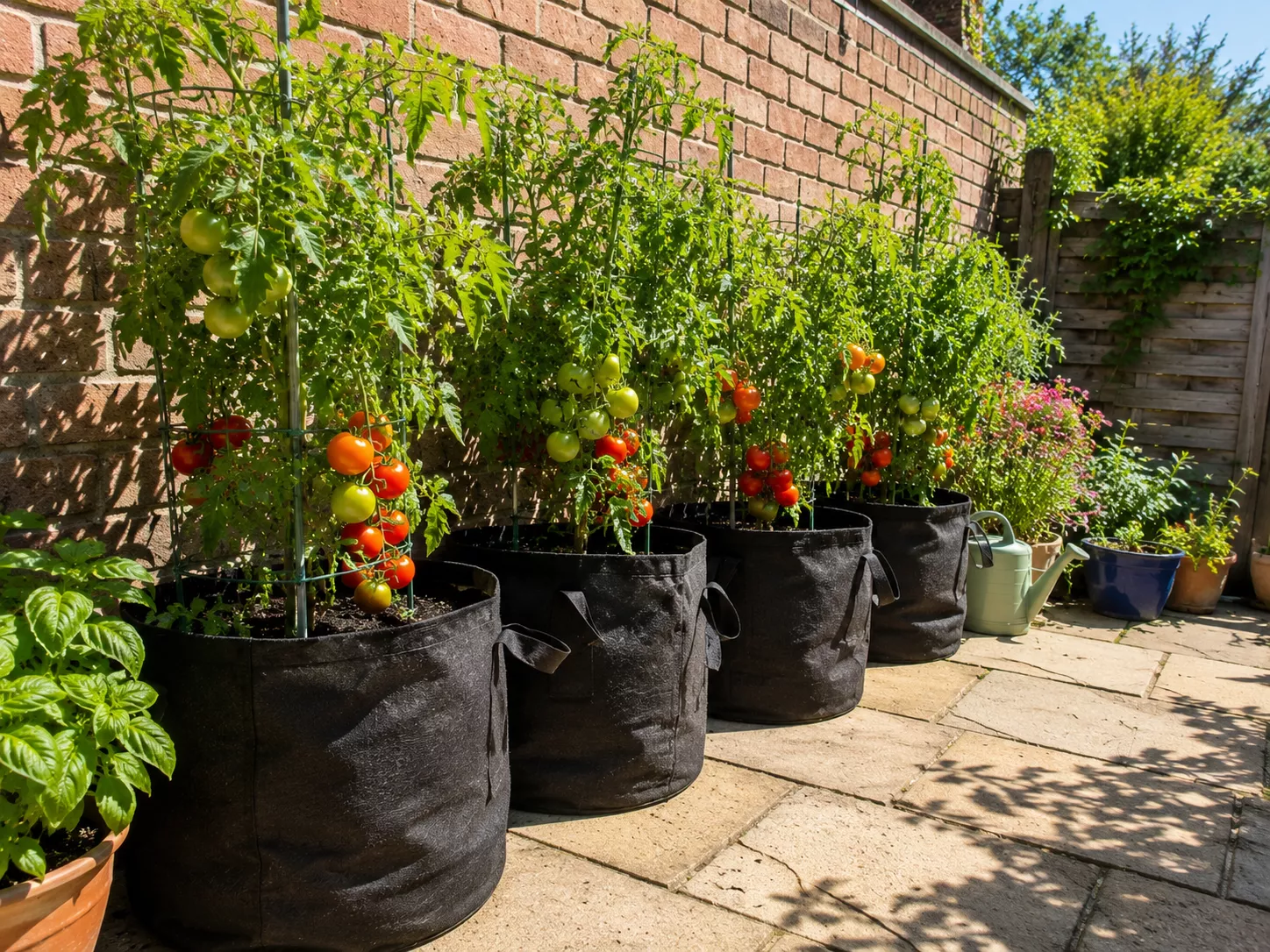
Put grow bags in the sunniest sheltered place you have.
Tomatoes need warmth and sunlight to grow well.
Choose the sunniest spot you have before filling the bags. Once a grow bag is full of damp compost, it becomes much heavier and harder to move.
Tomatoes need at least 6 to 8 hours of direct sunlight per day. In cooler climates, more sun is better. If you can give them 8 to 10 hours, they will usually grow and ripen more strongly.
A good location for tomato grow bags is:
- Sunny for most of the day
- Sheltered from strong wind
- Close to a water source
- Easy to reach every day
- Level and stable
- Away from heavy shade
- Warm without becoming scorching hot
Patios, balconies, driveways, greenhouses, polytunnels, and sunny garden edges can all work.
If you are growing on a balcony, check how windy it is. Tall tomato plants in grow bags can catch the wind easily. You may need a wall, railing, trellis, or heavy support to keep everything stable.
If you are growing in a very hot spot, such as against a south-facing wall, watch the compost carefully. The bags may dry out quickly during hot weather.
Choosing the Best Grow Bag Size for Tomatoes
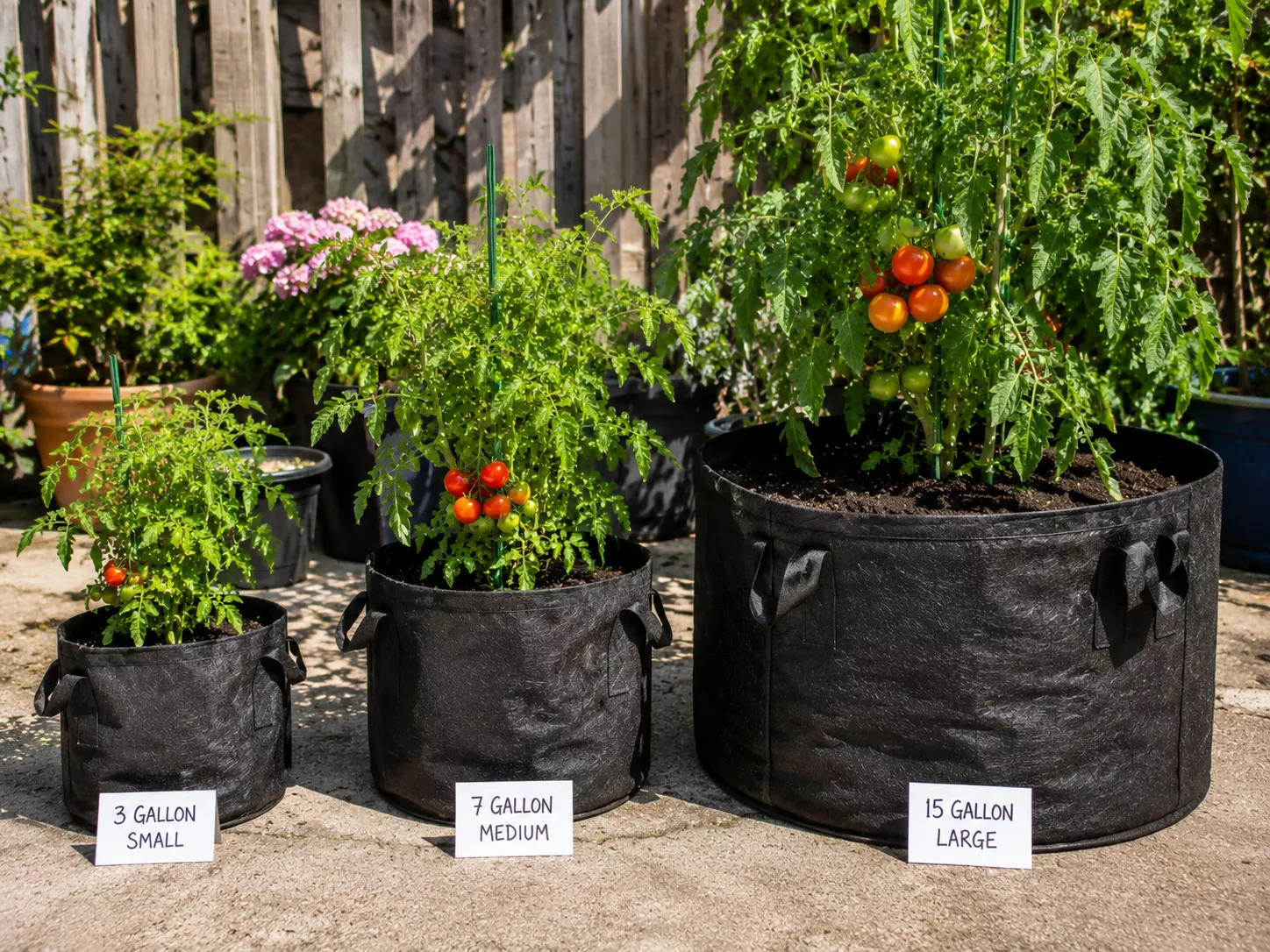
Bigger grow bags hold more compost, water, and nutrients.
The size of the grow bag matters a lot.
One of the most common mistakes is using a bag that is too small. A small grow bag dries out quickly, runs out of nutrients faster, and gives the roots less space.
For healthy tomato plants, bigger is usually better.
As a simple guide:
- 2 to 3 gallon grow bag: only for tiny dwarf or micro tomatoes
- 5 gallon grow bag: minimum size for compact bush tomatoes
- 7 to 10 gallon grow bag: better for most determinate tomatoes
- 10 to 15 gallon grow bag: good for larger plants and stronger harvests
- 15 to 20 gallon grow bag: best for indeterminate, beefsteak, or vigorous vining tomatoes
If you are a beginner, a 10 gallon grow bag is a very practical size for many tomato plants.
It gives the roots more space than a tiny bag, but it is still manageable on a patio.
For large indeterminate tomatoes, use 15 to 20 gallons if possible. These plants grow tall, produce for a long time, and need more water, food, and root space.
Can You Grow More Than One Tomato Plant in One Grow Bag?
In most cases, it is better to grow one tomato plant per grow bag.
This is especially true if the bag is 5 to 10 gallons.
One plant per bag gives each tomato:
- More root space
- Better airflow
- Better access to water
- Better access to nutrients
- Less competition
- Easier support
- Easier pruning and harvesting
If you have a very large grow bag, such as a long rectangular growing bag or a 20 to 30 gallon fabric bed, you may be able to grow two compact tomato plants.
But for beginners, keep it simple.
One tomato plant in one decent-sized grow bag is easier to manage and usually gives better results than squeezing in too many plants.
Best Type of Grow Bag for Tomatoes
There are different types of grow bags, but fabric grow bags are usually the best choice for tomatoes.
Look for bags that are:
- Made from strong breathable fabric
- UV-resistant
- Thick enough to hold their shape
- Strongly stitched
- Deep enough for tomato roots
- Wide enough to stay stable
- Fitted with strong handles if you need to move them
Handles are useful, but remember that a full grow bag with wet compost and a large tomato plant can be very heavy. Do not rely on weak handles once the plant is fully grown.
Black grow bags are common and work well in many climates because they warm up quickly in spring. In very hot climates, lighter-coloured bags may help keep roots cooler.
Avoid very thin, cheap bags if you want to reuse them for several seasons. They may tear, collapse, or degrade quickly in sunlight.
Best Tomato Varieties for Grow Bags
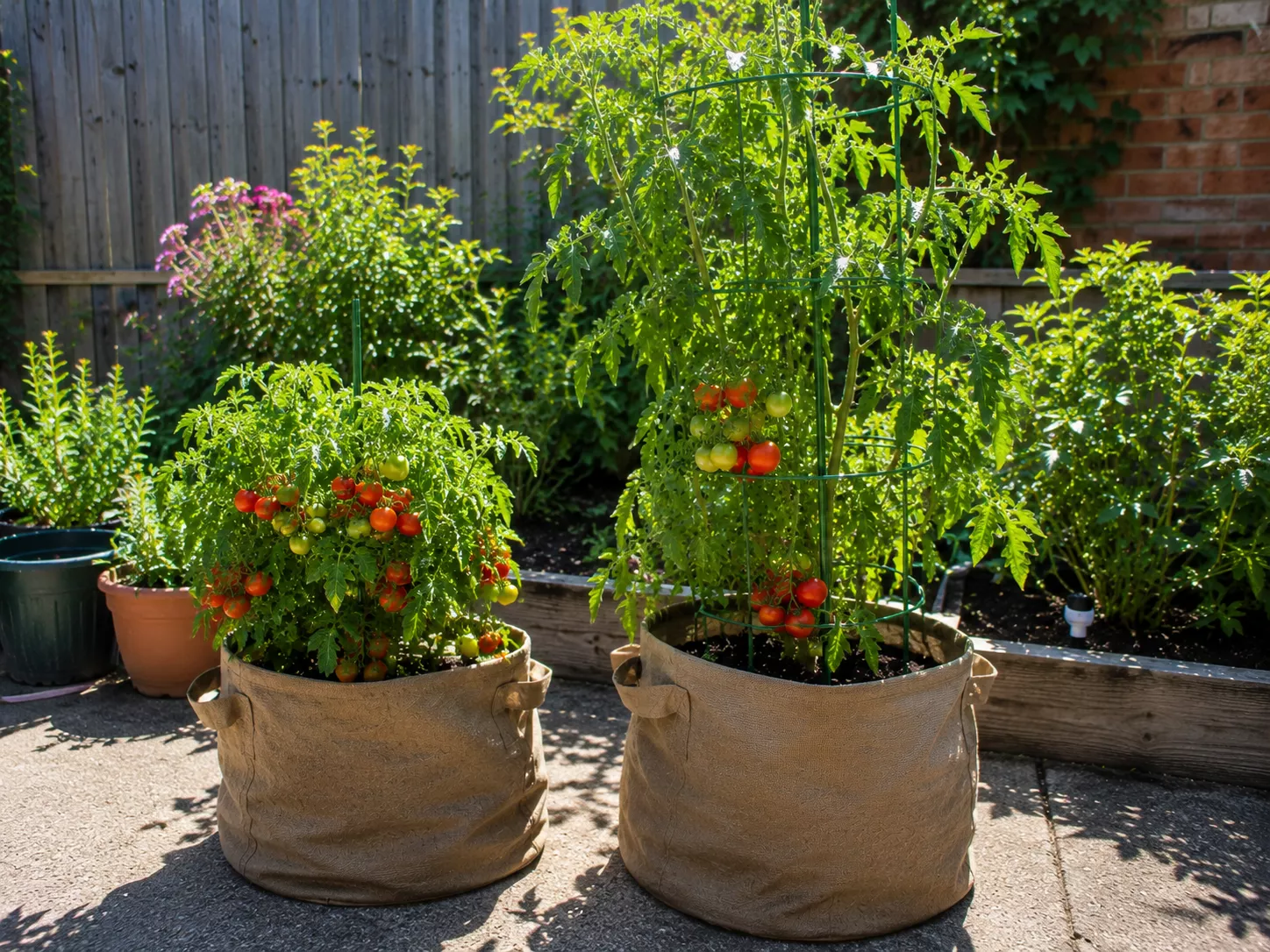
Compact tomato varieties are easiest for grow bags, but tall varieties can work with bigger bags and strong support.
You can grow many tomato varieties in grow bags, but some are much easier than others.
The best choice depends on the size of your bag and how much support you can provide.
The two main types are:
- Determinate tomatoes
- Indeterminate tomatoes
Determinate Tomatoes for Grow Bags
Determinate tomatoes are often called bush tomatoes.
They grow to a more controlled size, produce most of their crop over a shorter period, and are usually easier to manage in containers.
These are the easiest tomatoes for grow bags.
Determinate tomatoes are good if you want:
- Compact plants
- Easier support
- Less pruning
- A neater patio or balcony
- A harvest that comes in a shorter window
- A beginner-friendly option
Good determinate and compact tomato varieties for grow bags include:
Patio PrincessTiny TimRomaBush Early GirlGlacierPlum RegalRed RobinWindow Box Roma
Small bush varieties can grow in smaller bags, but they still perform better with enough root space.
For most determinate tomatoes, aim for at least a 7 to 10 gallon grow bag.
Indeterminate Tomatoes for Grow Bags
Indeterminate tomatoes are often called vining tomatoes.
They keep growing, flowering, and producing fruit until cold weather stops them. They can grow very tall, so they need bigger grow bags and stronger support.
Indeterminate tomatoes can grow well in grow bags, but they need more care.
They are good if you want:
- A long harvest season
- Cherry tomatoes over many weeks
- Tall plants trained upwards
- More fruit from vertical space
- A productive greenhouse or patio setup
Good indeterminate tomatoes for grow bags include:
SungoldSweet MillionGardener's DelightChocolate CherryAlicanteMoneymakerCherokee Purple
For indeterminate tomatoes, use at least a 15 gallon grow bag if possible. A 20 gallon bag is even better for large plants.
You will also need tall stakes, strong cages, a trellis, or a string support system.
For more help choosing varieties, read: Best Tomato Varieties for Home Gardens.
Best Tomato Types for Grow Bags
Some tomato types are easier in grow bags than others.
Cherry Tomatoes
Cherry tomatoes are one of the best choices for grow bags.
They usually ripen earlier, produce heavily, and are easier for beginners. Many cherry tomatoes are indeterminate, so they still need support, but the fruit is smaller and often ripens reliably.
Good choices include:
SungoldSweet MillionSupersweet 100Gardener's DelightTumbling Tom
Patio and Dwarf Tomatoes
Patio and dwarf tomatoes are perfect for small grow bags, balconies, and compact spaces.
They stay small, look tidy, and are easy to manage.
Good choices include:
Tiny TimRed RobinPatio PrincessTumbling TomWindow Box Roma
Roma and Paste Tomatoes
Paste tomatoes are good if you want tomatoes for sauce, passata, soups, and cooking.
Many paste tomatoes are determinate, which makes them suitable for grow bags.
Good choices include:
RomaRoma VFPlum RegalSan Marzano NanoWindow Box Roma
Beefsteak Tomatoes
Beefsteak tomatoes can grow in grow bags, but they are not the easiest choice.
They produce large fruits, need more warmth, need strong support, and need steady watering. If the grow bag dries out too often, large fruits are more likely to split or develop blossom end rot.
If you want to grow beefsteaks in grow bags, choose a large bag of 15 to 20 gallons, use strong support, and keep watering consistent.
Best Potting Mix for Tomato Grow Bags
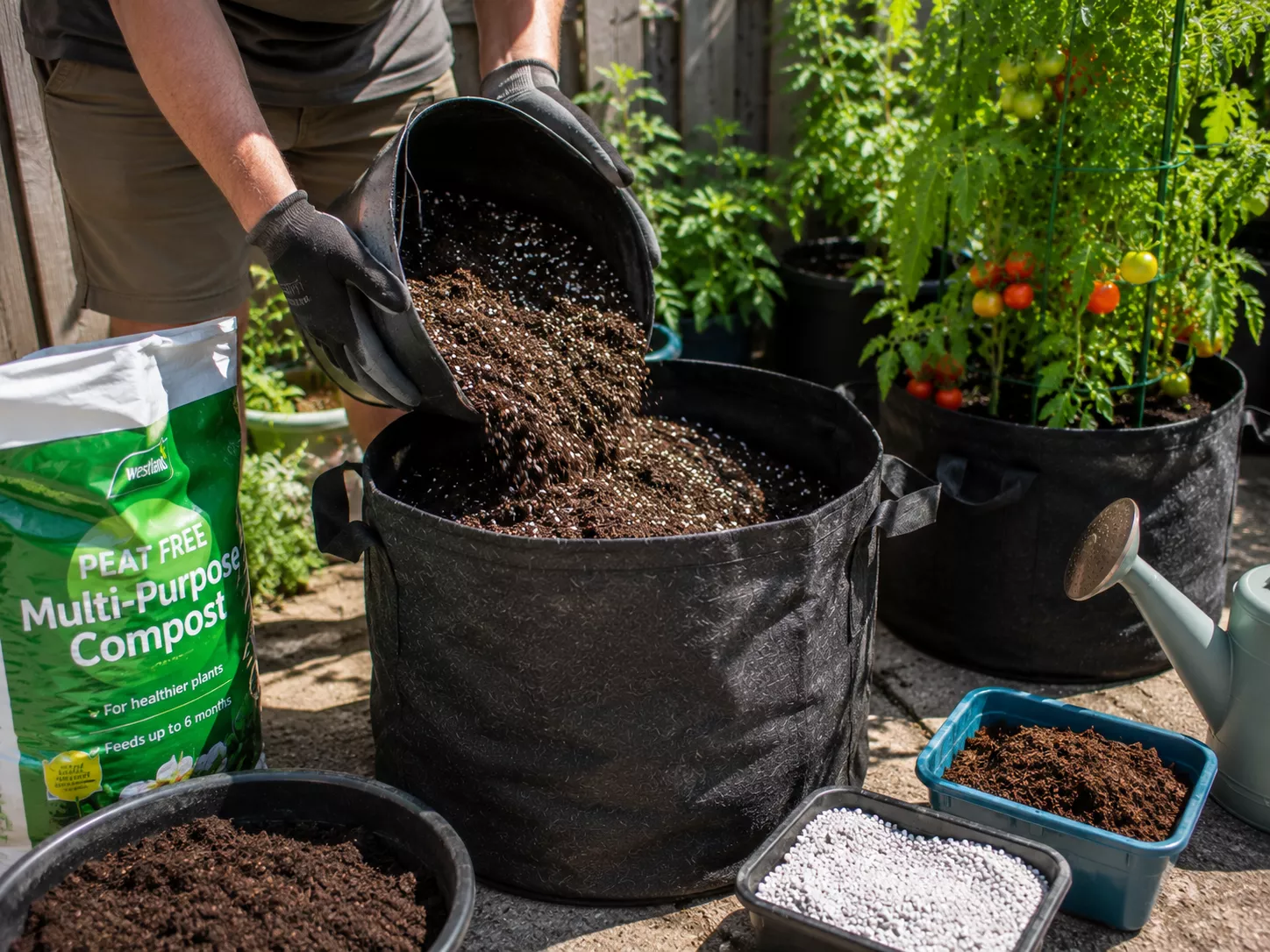
Use a light, rich potting mix that holds moisture but still drains well.
Do not fill tomato grow bags with ordinary garden soil.
Garden soil is usually too heavy for containers. It can compact inside the bag, drain poorly, and reduce air around the roots. It may also contain weed seeds, pests, or diseases.
Use a good-quality potting mix or multipurpose compost instead.
The best potting mix for grow bag tomatoes should be:
- Loose
- Fertile
- Moisture-retentive
- Well-draining
- Rich in organic matter
- Light enough for roots to grow through easily
A simple grow bag tomato mix is:
- 2 parts good-quality peat-free multipurpose compost or potting mix
- 1 part compost or well-rotted manure
- 1 part perlite, coarse compost, or fine bark for drainage and structure
You can also use a ready-made container compost and improve it with extra compost and a slow-release tomato fertiliser.
The goal is to create a mix that holds water without becoming soggy.
When you squeeze a handful of the mix, it should hold together slightly but still crumble apart easily.
Should You Add Fertiliser Before Planting?
Yes, it is usually helpful to add some slow-release fertiliser before planting.
Tomatoes are hungry plants, and grow bags contain a limited amount of compost. Nutrients can also wash out more quickly because grow bags drain so well.
Before planting, mix in:
- A slow-release tomato fertiliser
- Or a balanced organic fertiliser
- Or compost and a suitable container fertiliser
Always follow the packet instructions. More fertiliser is not always better.
Too much nitrogen can give you a big leafy plant with fewer flowers and fewer tomatoes.
Once the plant starts flowering and fruiting, switch to a tomato feed that supports fruit production.
Should You Add Lime or Calcium?
Tomatoes need calcium for healthy fruit development, but blossom end rot is often caused by inconsistent watering rather than a simple lack of calcium in the compost.
If your potting mix is very acidic, garden lime may help adjust the pH and add calcium. Some gardeners also add gypsum or a calcium-based amendment.
However, do not rely on calcium alone to prevent blossom end rot.
The most important prevention is steady watering.
If the plant dries out badly, it cannot move calcium properly to the fruit, even if calcium is present in the compost.
When to Start Tomato Seeds for Grow Bags
Tomatoes need warmth to grow well, so most gardeners start seeds indoors before moving plants outside.
Start tomato seeds indoors about 6 to 8 weeks before your last expected frost date.
Use seed compost or a light seed-starting mix. Keep the compost moist but not soaking wet.
Tomato seeds germinate best in warmth. Once seedlings appear, move them into strong light as soon as possible.
Weak light creates leggy seedlings. These are tall, thin plants that stretch towards the light and may struggle later.
To grow strong seedlings:
- Give them bright light
- Keep them warm but not too hot
- Water gently
- Pot them on when roots fill the seed tray
- Brush your hand lightly over the tops to encourage sturdier stems
- Avoid letting them become rootbound
If you do not want to start seeds, buying young tomato plants from a garden centre is perfectly fine.
Choose short, sturdy plants with healthy green leaves.
Hardening Off Tomato Plants
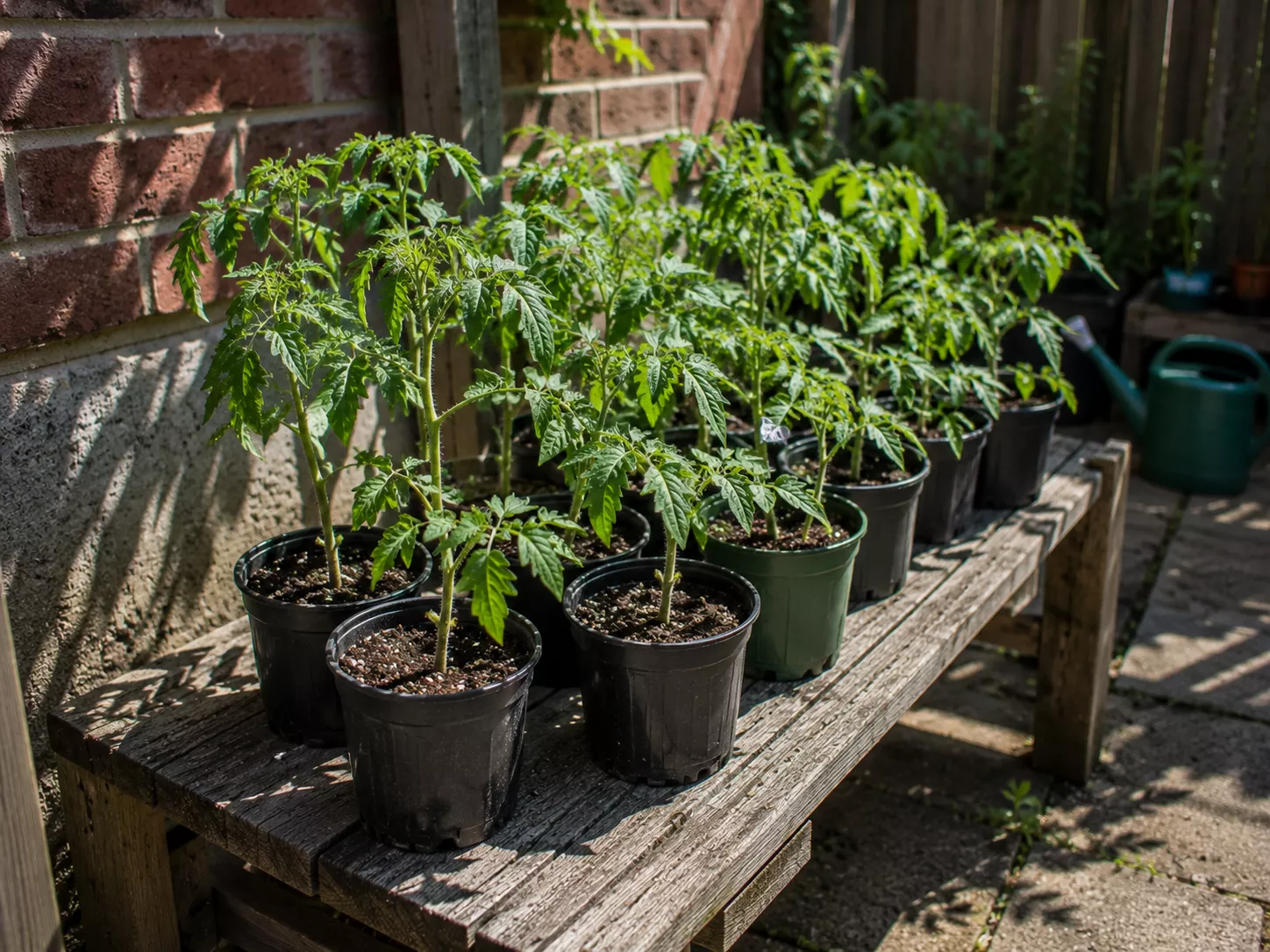
Harden off tomato plants before moving them into grow bags outdoors.
Before planting tomatoes into outdoor grow bags, harden them off.
Hardening off means gradually introducing indoor-grown plants to outdoor conditions.
Indoor plants are not used to strong sunlight, wind, cool nights, and changing weather. If you move them outside suddenly, they can suffer from shock.
Harden off tomato plants over 7 to 10 days.
A simple hardening-off routine:
- Put plants outside in a sheltered, shaded place for 1 to 2 hours.
- Bring them back inside or into a greenhouse.
- Increase the time outside each day.
- Slowly introduce more direct sunlight.
- Keep them protected from strong wind.
- Do not leave them out on cold nights.
- Plant them once they can handle a full day outside.
Do not rush this stage. A well-hardened plant usually establishes faster and grows away more strongly.
When to Plant Tomatoes in Grow Bags
Plant tomatoes in grow bags after the risk of frost has passed.
Tomatoes hate cold weather. If they are planted out too early, they may survive but sit still for weeks without growing properly.
Wait until:
- The last frost has passed
- Night temperatures are consistently above 10°C to 13°C
- The compost has warmed up
- The plants have been hardened off
- The plants are strong, healthy, and not too small
In the UK, outdoor planting is often done from late May to early June, depending on your area and the weather that year.
If you are growing in a greenhouse, you can usually plant earlier because the plants are protected.
How to Plant Tomatoes in Grow Bags
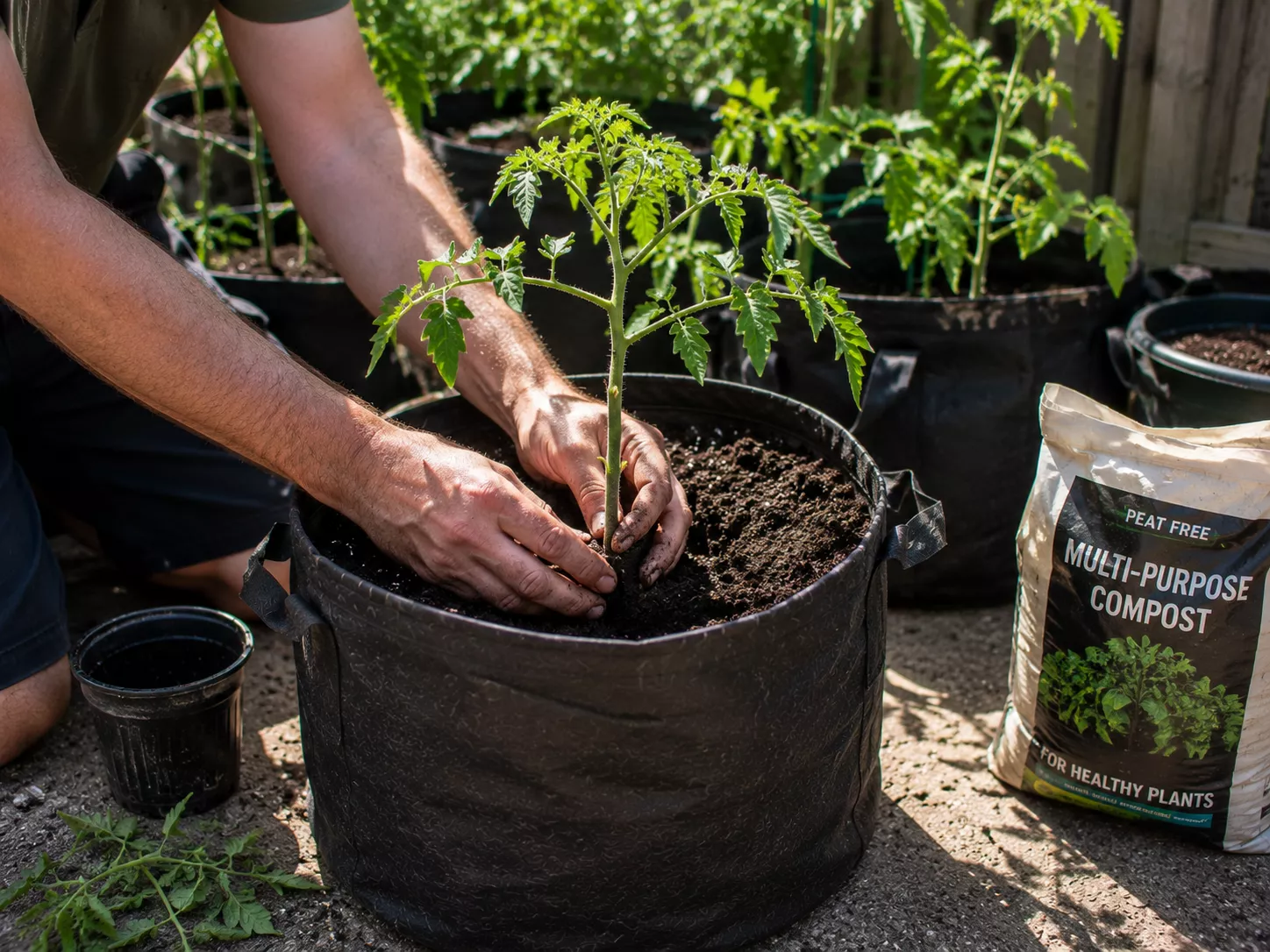
Plant tomatoes deeply so they can grow extra roots along the buried stem.
Tomatoes are special because they can grow roots from their buried stems.
This means you can plant them deeper than they were growing in their small pot.
Deep planting helps create a stronger root system, which helps the plant take up more water and nutrients.
To plant tomatoes in grow bags:
- Place the grow bag in its final sunny position.
- Fill the bag with moist potting mix.
- Leave a few inches of space at the top for watering and mulch.
- Remove the lowest leaves from the tomato plant.
- Dig a deep planting hole in the centre of the bag.
- Place the tomato plant into the hole.
- Bury part of the stem below the compost.
- Firm the compost gently around the plant.
- Water well.
- Add the support straight away.
You can bury up to two-thirds of a tall tomato seedling if needed, as long as healthy leaves remain above the compost.
Trench Planting in Grow Bags
If your tomato seedling is tall and leggy, you can use trench planting.
Instead of digging a deep hole, make a shallow trench across the top of the grow bag. Lay the plant sideways with most of the stem under the compost and gently angle the leafy top upwards.
Roots will grow from the buried stem.
This method works well because the upper layer of compost is usually warmer than the deeper compost, especially early in the season.
Add Support at Planting Time
Do not wait until the tomato plant is large before adding support.
Install stakes, cages, or trellises when you plant. This avoids damaging the roots later.
Tomato supports help:
- Keep plants upright
- Prevent broken stems
- Keep fruit off the ground
- Improve airflow
- Make pruning easier
- Make harvesting easier
- Stop plants from flopping over the grow bag
Even bush tomatoes can become heavy when loaded with fruit.
Best Supports for Tomatoes in Grow Bags
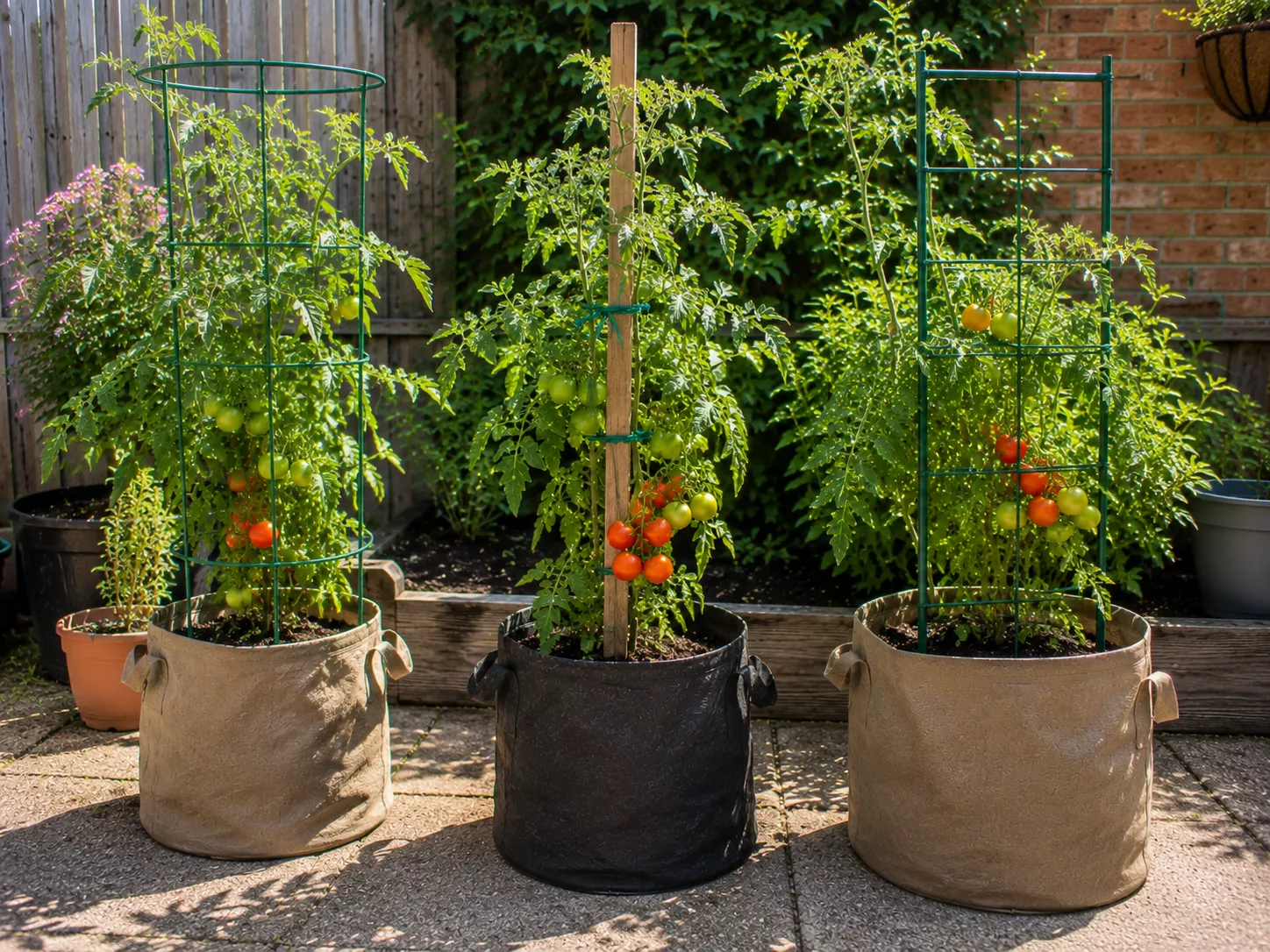
Install supports early before the roots fill the grow bag.
The best support depends on the tomato variety.
Tomato Cages
Tomato cages are good for determinate or bush tomatoes.
Choose strong cages if possible. Cheap thin cages can bend when plants become heavy.
Push the cage in when you plant so the roots are not disturbed later.
Stakes
Stakes are useful for indeterminate tomatoes.
Use tall, strong stakes for vining varieties. A stake should be deep enough to stand firmly and tall enough to support the plant as it grows.
Tie the tomato stem loosely to the stake using soft garden twine, cloth strips, tomato clips, or plant ties.
Do not tie the stem too tightly. The stem needs room to thicken.
Trellis or String Support
A trellis or string support is excellent if your grow bags are against a wall, fence, greenhouse frame, or balcony structure.
You can train indeterminate tomatoes upward and keep the plants tidy.
This is especially useful for cherry tomatoes, which can grow very tall and productive.
Extra Wind Support
Grow bags can be less stable than heavy pots, especially when the plant becomes tall.
If your area is windy:
- Place grow bags against a sheltered wall
- Use heavier, wider bags
- Secure stakes to a fence or railing
- Group bags together for stability
- Avoid very tall varieties in exposed spots
- Check supports after storms
A tall tomato plant full of fruit can act like a sail in strong wind.
Watering Tomatoes in Grow Bags
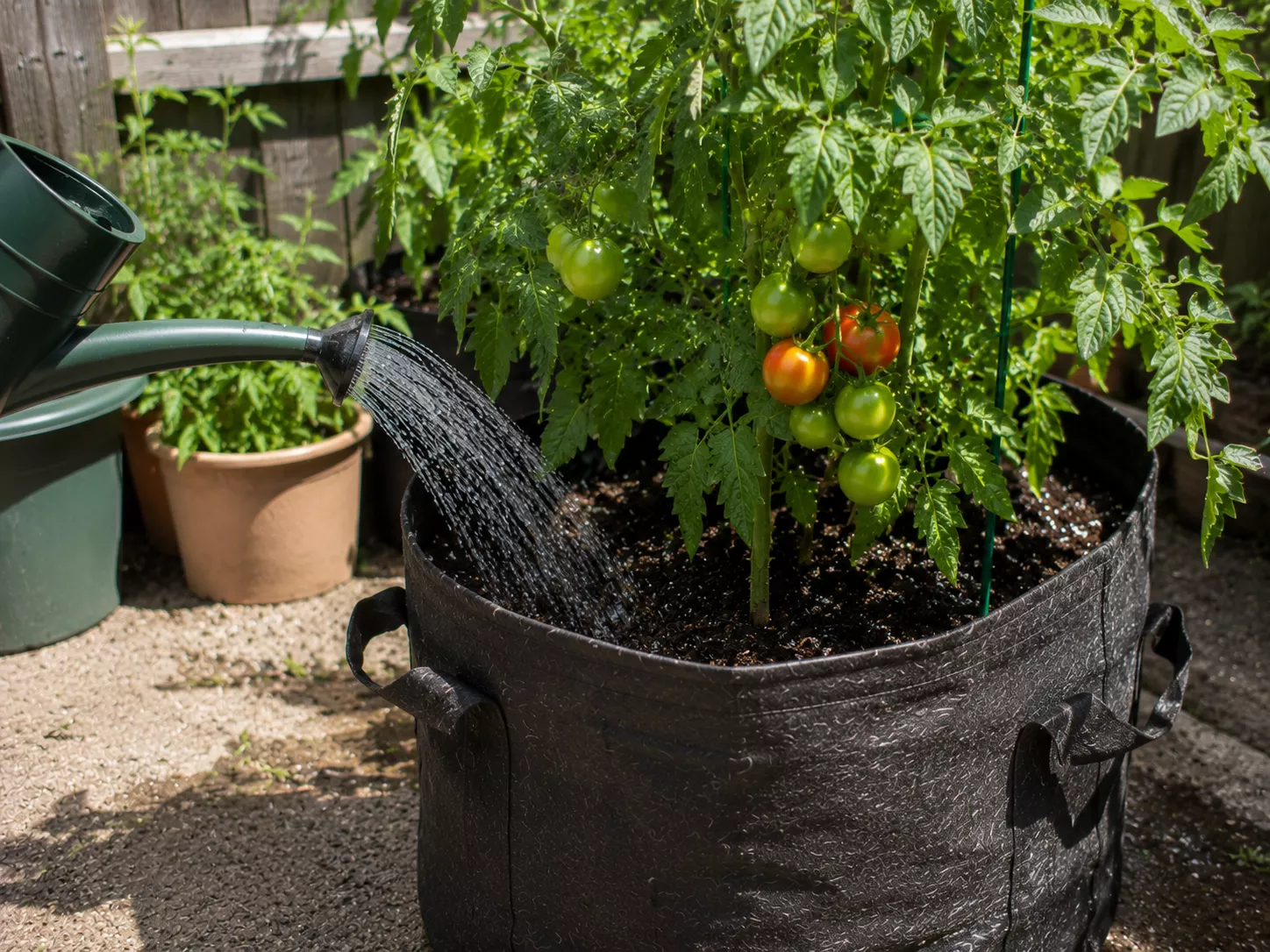
Water grow bag tomatoes consistently and always aim for the compost, not the leaves.
Watering is the most important part of growing tomatoes in grow bags.
Because fabric grow bags breathe and drain so well, the compost can dry out faster than it would in the ground or in a plastic pot.
That is good for root health, but it means you need to check the plants often.
The goal is to keep the compost evenly moist.
Not soaking wet.
Not bone dry.
Evenly moist.
Inconsistent watering can cause:
- Blossom end rot
- Fruit cracking
- Leaf curl
- Flower drop
- Poor fruit development
- Weak growth
- Plant stress
How Often Should You Water Tomatoes in Grow Bags?
There is no perfect schedule because weather changes.
A tomato in a grow bag may need watering every few days in mild weather, once a day in warm weather, and twice a day during very hot, windy weather.
Instead of following a strict timetable, check the compost.
Use the finger test:
Push your finger about 2 inches into the compost. If it feels dry at that depth, water the plant.
Water slowly and deeply until you see water beginning to drain from the bottom or sides of the grow bag.
That tells you the whole root area has been moistened.
Best Time of Day to Water
Morning is usually the best time to water tomatoes.
Morning watering gives the plant moisture before the heat of the day and allows any accidental splashes on the leaves to dry quickly.
If the plant is wilting badly in the evening and the compost is dry, water it then as well. Do not leave a tomato plant dry overnight just because morning is ideal.
In hot weather, tomatoes in grow bags may need both morning and evening watering.
Water the Compost, Not the Leaves
Always aim water at the base of the plant.
Try not to wet the leaves.
Wet tomato foliage increases the risk of fungal disease, especially in still, humid, or crowded spaces.
Good watering methods include:
- Watering can directed at the compost
- Hose on a gentle setting
- Drip irrigation
- Bottle drip system
- Self-watering spikes
- Soaker line
Avoid blasting the compost with a strong jet of water because it can expose roots and splash compost onto the leaves.
Mulching Tomato Grow Bags
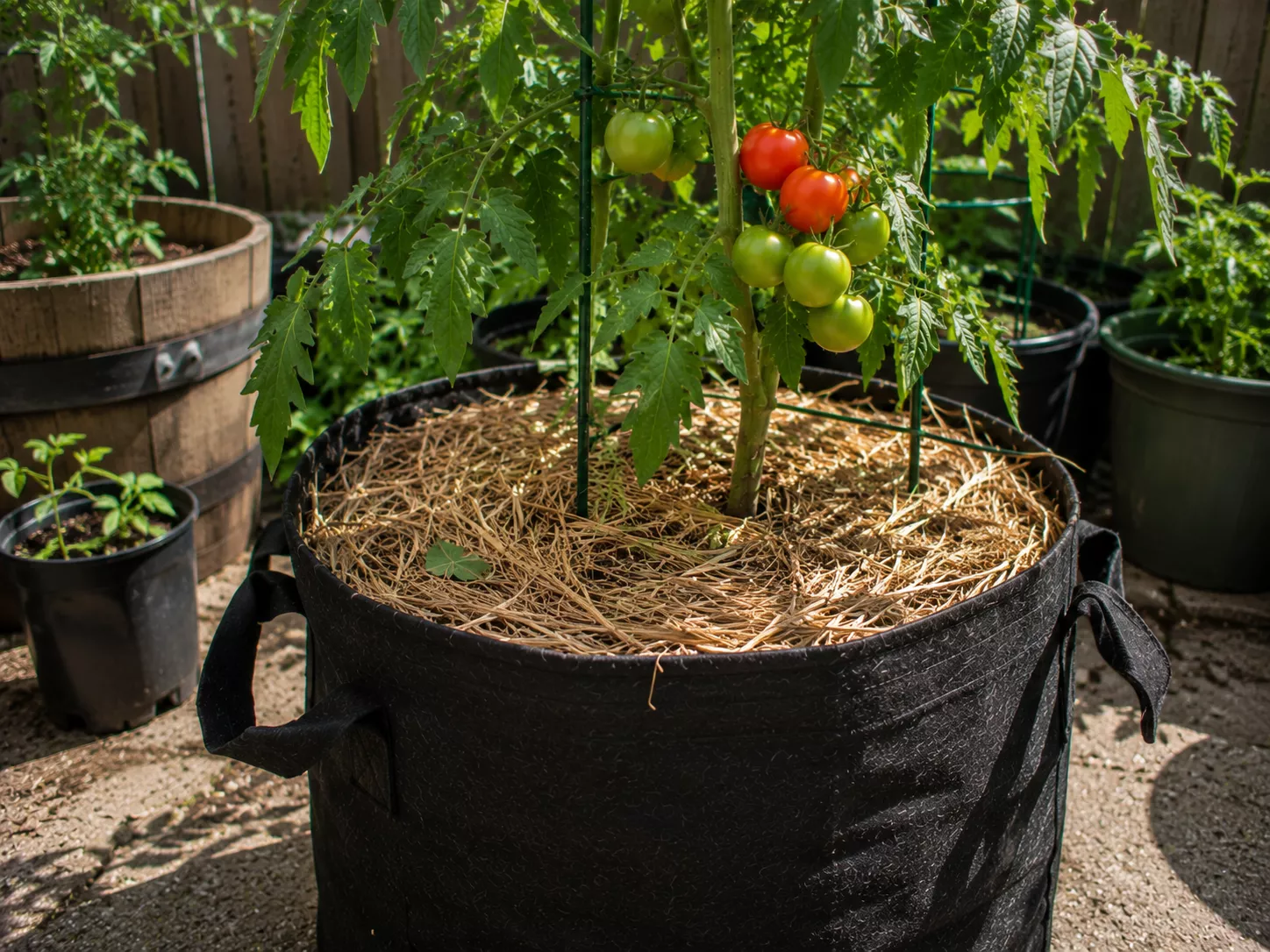
Mulch helps grow bags hold moisture for longer.
Mulch is very helpful when growing tomatoes in grow bags.
A layer of mulch on top of the compost helps slow down evaporation and keeps moisture more even.
This is especially useful because grow bags dry out quickly.
Good mulch materials include:
- Straw
- Shredded leaves
- Grass clippings from untreated lawns
- Compost
- Leaf mould
- Fine bark
Apply a layer around 1 to 2 inches deep on top of the grow bag.
Leave a small gap around the tomato stem so wet mulch does not sit directly against it.
Mulch helps:
- Hold moisture
- Reduce watering stress
- Keep the compost cooler in hot weather
- Reduce splashing
- Reduce weeds
- Protect the top layer of compost
For grow bags, mulch is not just a nice extra. It can make watering much easier.
Feeding Tomatoes in Grow Bags
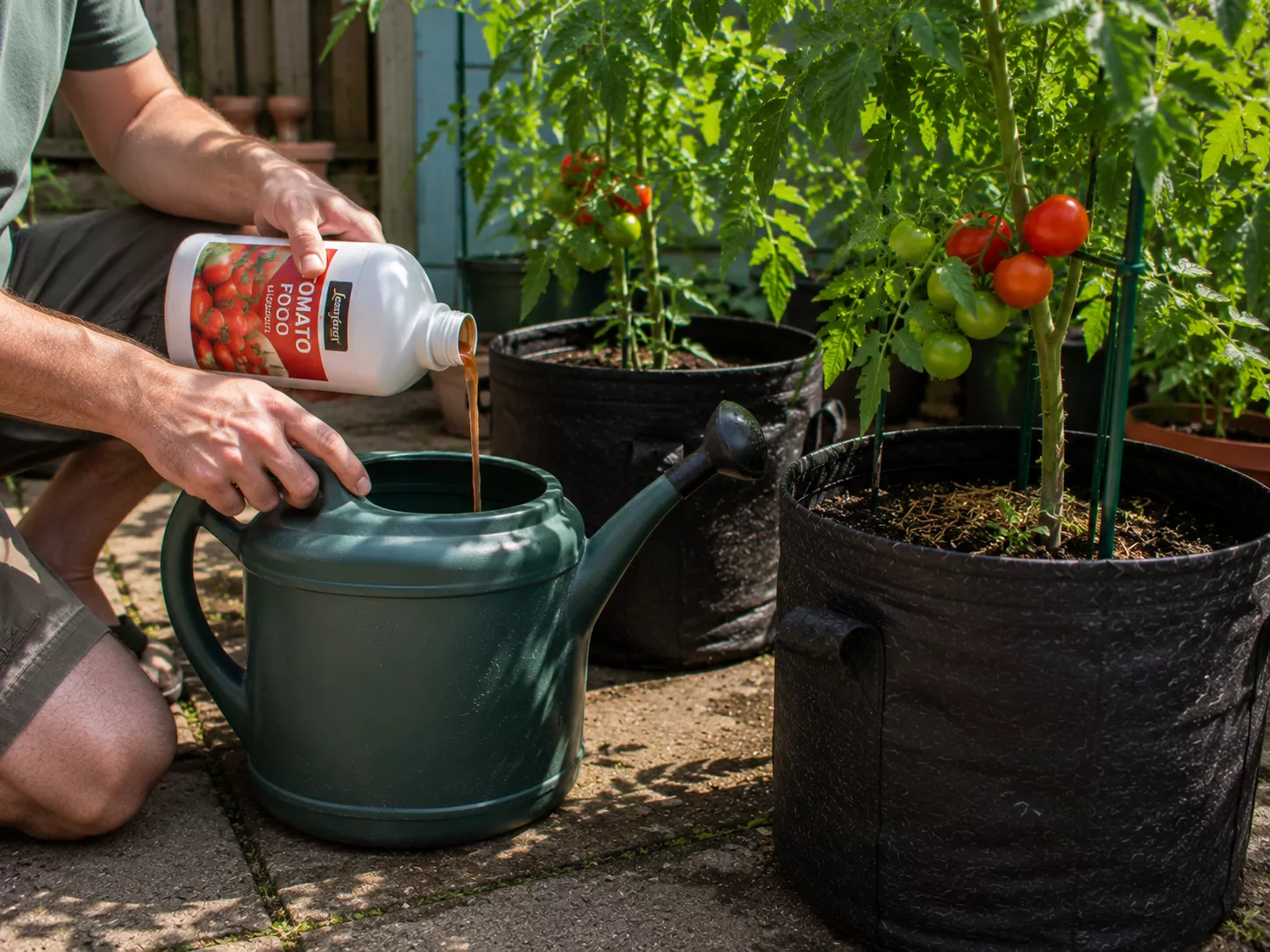
Tomatoes in grow bags need regular feeding because nutrients wash out faster.
Tomatoes are heavy feeders.
They need nutrients to grow strong stems, healthy leaves, flowers, and fruit.
In grow bags, feeding is especially important because there is only a limited amount of compost. Regular watering can also wash nutrients out of the bag.
Start with a good potting mix and some slow-release fertiliser at planting time.
Then begin feeding once the first fruits start to form.
A simple feeding routine is:
- Use compost or slow-release fertiliser at planting
- Start liquid tomato feed when the first small fruits appear
- Feed every 1 to 2 weeks during fruiting
- Follow the instructions on the feed bottle or packet
- Water before feeding if the compost is very dry
Use a tomato feed that is higher in potassium once the plant begins flowering and fruiting.
Potassium helps support fruit development and ripening.
Avoid using too much high-nitrogen fertiliser late in the season. Too much nitrogen encourages lots of leafy growth but can reduce flowering and fruiting.
Signs Your Grow Bag Tomato Needs Feeding
A tomato plant may need more nutrition if you notice:
- Pale leaves
- Slow growth
- Small fruit
- Weak stems
- Poor flowering
- Older leaves yellowing evenly
- Plant looking tired during fruiting
However, yellow leaves can also be caused by watering problems, cold, disease, or natural ageing.
Do not automatically add more fertiliser every time a leaf turns yellow.
Check the whole plant and the growing conditions first.
For a full troubleshooting guide, read: Why Are My Tomato Leaves Turning Yellow?.
Pruning Tomatoes in Grow Bags
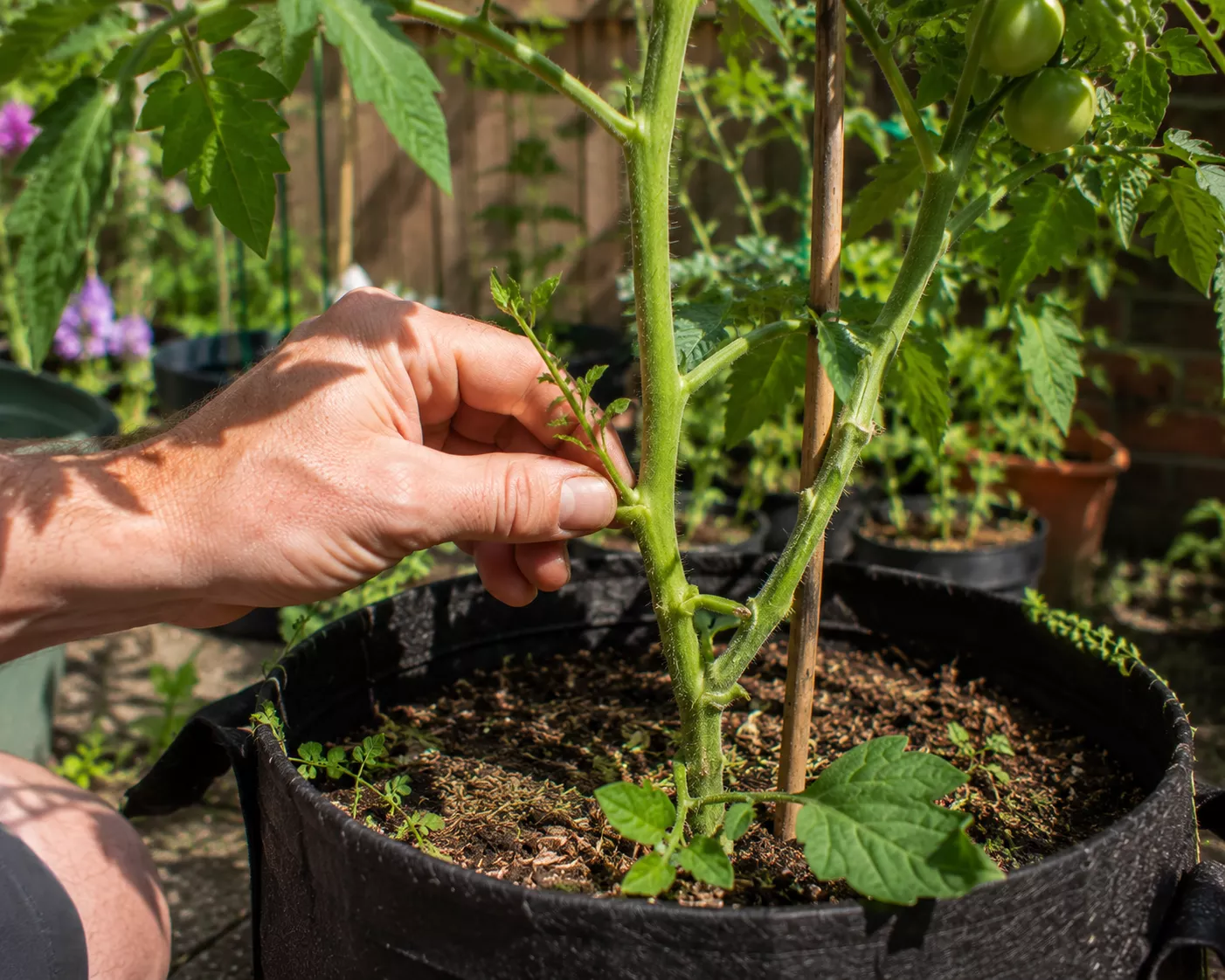
Prune indeterminate tomatoes to improve airflow and keep plants manageable.
Pruning depends on the type of tomato you are growing.
The simple rule is:
- Prune indeterminate tomatoes
- Do not heavily prune determinate tomatoes
Pruning Indeterminate Tomatoes
Indeterminate tomatoes grow continuously, so they can become tangled and crowded.
They produce side shoots called suckers. These grow in the joint between the main stem and a leaf branch.
Removing some suckers helps:
- Improve airflow
- Keep the plant manageable
- Focus growth upwards
- Make harvesting easier
- Reduce overcrowding in small spaces
To prune indeterminate tomatoes:
- Find the small sucker between the main stem and a leaf branch.
- Pinch it out with your fingers while it is small.
- Use clean scissors for larger shoots.
- Remove weak, damaged, or crowded growth.
- Tie the main stem to its support as it grows.
You do not have to remove every sucker. Many home gardeners allow two or three main stems.
The goal is a plant that is open, supported, and easy to water and harvest.
Pruning Determinate Tomatoes
Determinate tomatoes should not be heavily pruned.
They produce most of their fruit over a shorter period. If you remove too much healthy growth, you may reduce your harvest.
For determinate tomatoes, only remove:
- Yellow leaves
- Diseased leaves
- Leaves touching the compost
- Very low growth with poor airflow
- Broken or damaged stems
Keep most of the healthy foliage because the plant needs leaves to feed the fruit and protect tomatoes from sunscald.
Remove Lower Leaves
Once the tomato plant is established, remove the lowest leaves from the bottom of the plant.
This is especially helpful in grow bags because the leaves can sit close to the compost.
Removing lower leaves helps:
- Improve airflow
- Make watering easier
- Reduce disease splash
- Keep foliage away from damp compost
Remove leaves gradually. Do not strip the plant bare.
A good target is to keep the lower 8 to 12 inches of the main stem clear once the plant is growing strongly.
Pollinating Tomatoes in Grow Bags
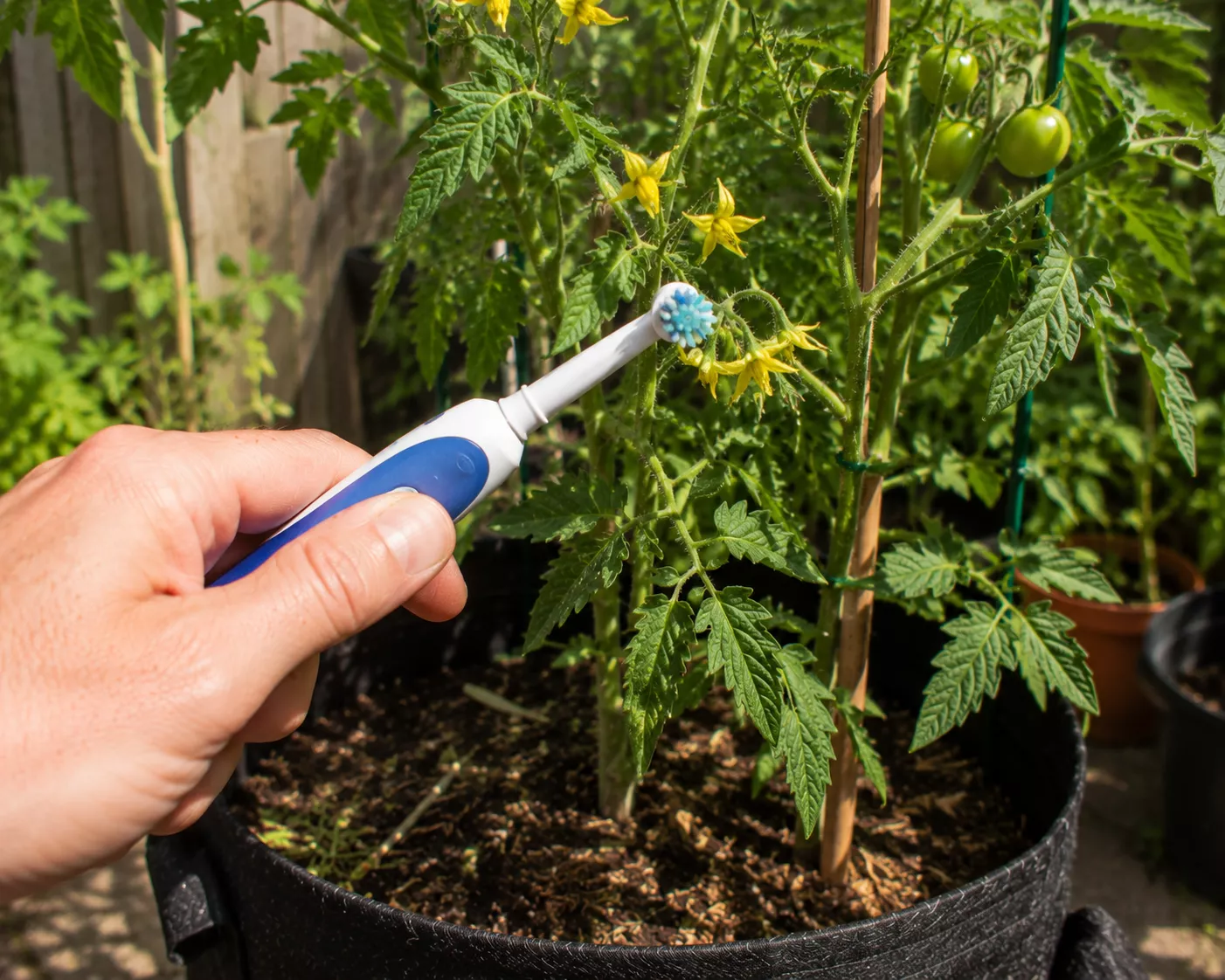
In still spaces, gently shaking tomato flowers can help fruit set.
Tomatoes are self-pollinating, which means each flower contains both male and female parts.
But the flowers still need movement to release pollen.
Outdoors, wind and bees usually do this naturally. But if your grow bags are in a sheltered patio, greenhouse, balcony corner, or still area, pollination may be weaker.
Signs of poor pollination include:
- Flowers dropping
- Lots of flowers but no fruit
- Small fruit set
- Poor harvest despite healthy leaves
You can help by gently shaking the plant or tapping flower clusters when flowers are open.
Some gardeners use an electric toothbrush near the flower stem to create vibration. You do not need to touch the flower directly. The vibration is the useful part.
This simple trick can help in greenhouses, balconies, and very sheltered gardens.
Common Grow Bag Tomato Problems
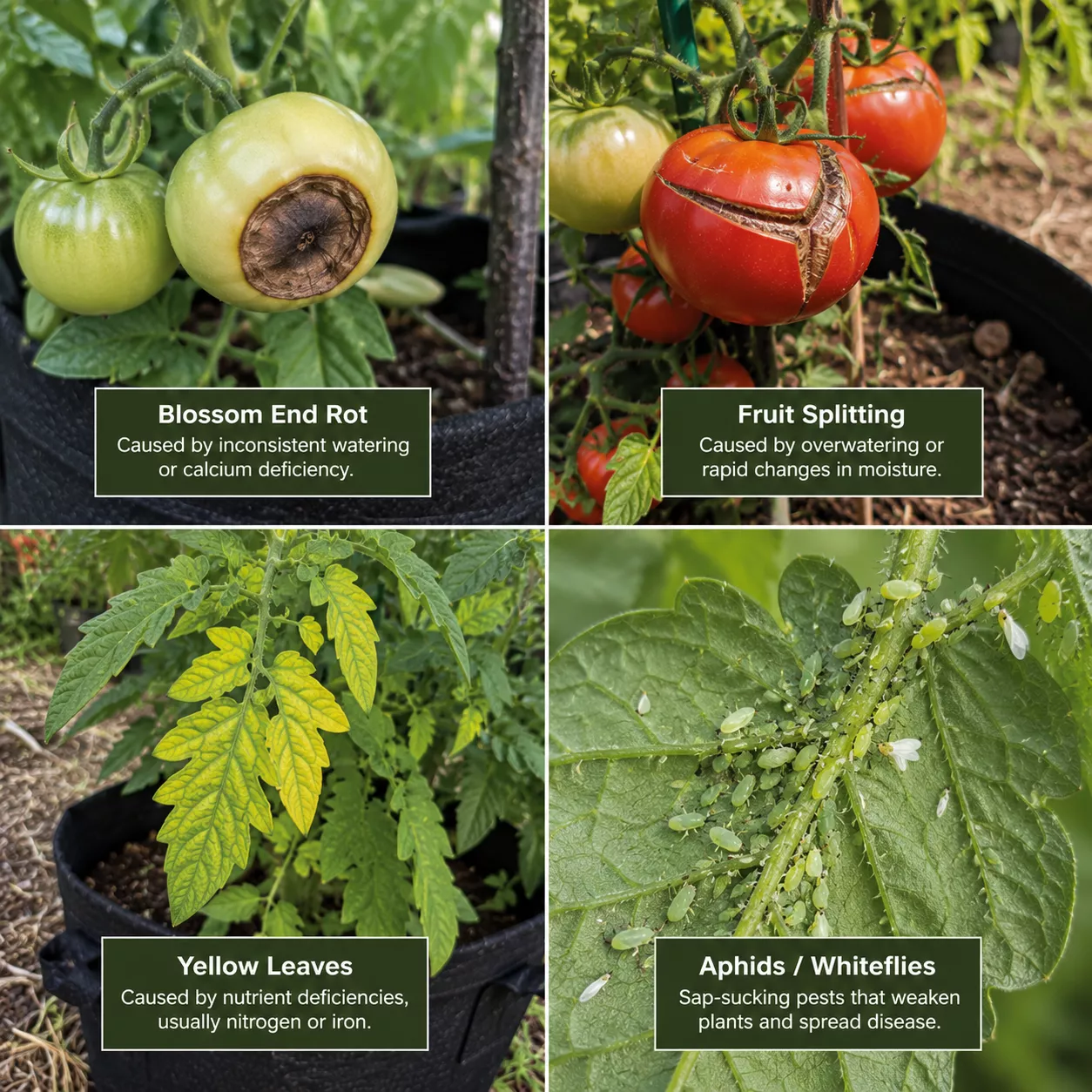
Most grow bag tomato problems are linked to watering, feeding, airflow, or support.
Grow bags make tomato growing easier in some ways, but problems can still happen.
The good news is that most grow bag tomato problems are preventable.
The main causes are:
- Inconsistent watering
- Grow bags that are too small
- Not enough feeding
- Poor airflow
- Weak support
- Overcrowding
- Too much shade
- Very hot or very cold weather
Check your plants daily if you can. A quick look at the leaves, flowers, fruit, and compost can help you spot problems early.
Blossom End Rot
Blossom end rot appears as a dark, sunken, leathery patch on the bottom of the tomato fruit.
It is often called a calcium problem, but in grow bags it is usually linked to inconsistent watering.
If the compost dries out too much, the plant cannot move calcium properly to the fruit. This can happen even when calcium is already present in the compost.
To reduce blossom end rot:
- Water consistently
- Do not let the grow bag dry out completely
- Use a large enough grow bag
- Mulch the top of the compost
- Avoid overfeeding with nitrogen
- Keep the plant growing steadily
- Avoid damaging roots
Removing affected fruit can help the plant focus on healthy new tomatoes.
Fruit Cracking and Splitting
Tomatoes can split when the plant gets a sudden rush of water after being dry.
The fruit swells quickly and the skin cracks.
This is common after heavy rain or irregular watering.
To reduce fruit cracking:
- Keep compost evenly moist
- Water before the plant becomes severely dry
- Mulch the grow bag
- Pick ripe fruit before heavy rain
- Choose crack-resistant varieties if this happens often
Cherry tomatoes are often more prone to splitting than thicker-skinned paste tomatoes.
Yellow Leaves
Yellow leaves can happen for many reasons.
Common causes include:
- Underwatering
- Overwatering
- Nutrient deficiency
- Cold weather
- Old lower leaves naturally dying
- Poor drainage
- Disease
- Root stress
A few yellow lower leaves on an older plant are not always a disaster.
But if many leaves turn yellow quickly, check the compost moisture, feeding routine, and leaf pattern.
If the leaves are yellowing with spots, patches, or wilting, disease may be involved.
Wilting Plants
A tomato plant in a grow bag may wilt because the compost is too dry.
This is very common in hot weather.
But wilting can also happen if the roots are too wet, damaged, or diseased.
Check the compost before watering.
If the compost is dry, water slowly and deeply.
If the compost is wet and the plant is still wilting, do not keep adding more water. Check for root problems, stem damage, or disease.
Flowers Dropping Without Fruit
Tomato flowers can drop if the plant is stressed.
Common causes include:
- Very hot weather
- Cold nights
- Poor pollination
- Underwatering
- Overfeeding with nitrogen
- Lack of sunlight
- Plant stress after transplanting
To help fruit set:
- Keep watering consistent
- Avoid overfeeding nitrogen
- Gently shake flower clusters
- Give plants enough sunlight
- Protect from extreme heat or cold
- Keep plants healthy and unstressed
Blight and Leaf Diseases
Grow bags can reduce some soil problems because you use fresh compost, but tomato leaves can still suffer from fungal diseases.
To reduce disease risk:
- Water the compost, not the leaves
- Avoid overcrowding
- Remove lower leaves
- Give plants space
- Improve airflow
- Remove diseased leaves quickly
- Clean supports at the end of the season
- Do not reuse diseased compost for tomatoes
If a plant becomes badly diseased, remove infected material and dispose of it in the rubbish rather than composting it.
Aphids and Whiteflies
Aphids and whiteflies are common on tomatoes, especially in sheltered places.
They suck sap from the plant and can cause curled leaves, sticky residue, and weak growth.
To manage them:
- Spray them off with water
- Remove badly infested leaves
- Encourage ladybirds and other beneficial insects
- Use insecticidal soap if needed
- Avoid overfeeding with nitrogen
Check the undersides of leaves because pests often hide there.
Tomato Hornworms and Caterpillars
Large caterpillars can eat tomato leaves quickly.
If leaves suddenly disappear, check the stems and undersides of leaves carefully.
Pick caterpillars off by hand and remove them.
Look for droppings on leaves or around the base of the plant. That is often the easiest clue.
Sunscald
Sunscald appears as pale, papery patches on tomato fruit.
It happens when fruit is exposed to strong direct sun, often after too much foliage has been removed.
To reduce sunscald:
- Do not over-prune
- Keep enough leaves to shade fruit
- Support plants properly
- Water consistently during hot weather
- Provide light afternoon shade in extreme heat
Leaves are not just decoration. They help feed the plant and protect the fruit.
Growing Tomatoes in Grow Bags on a Balcony
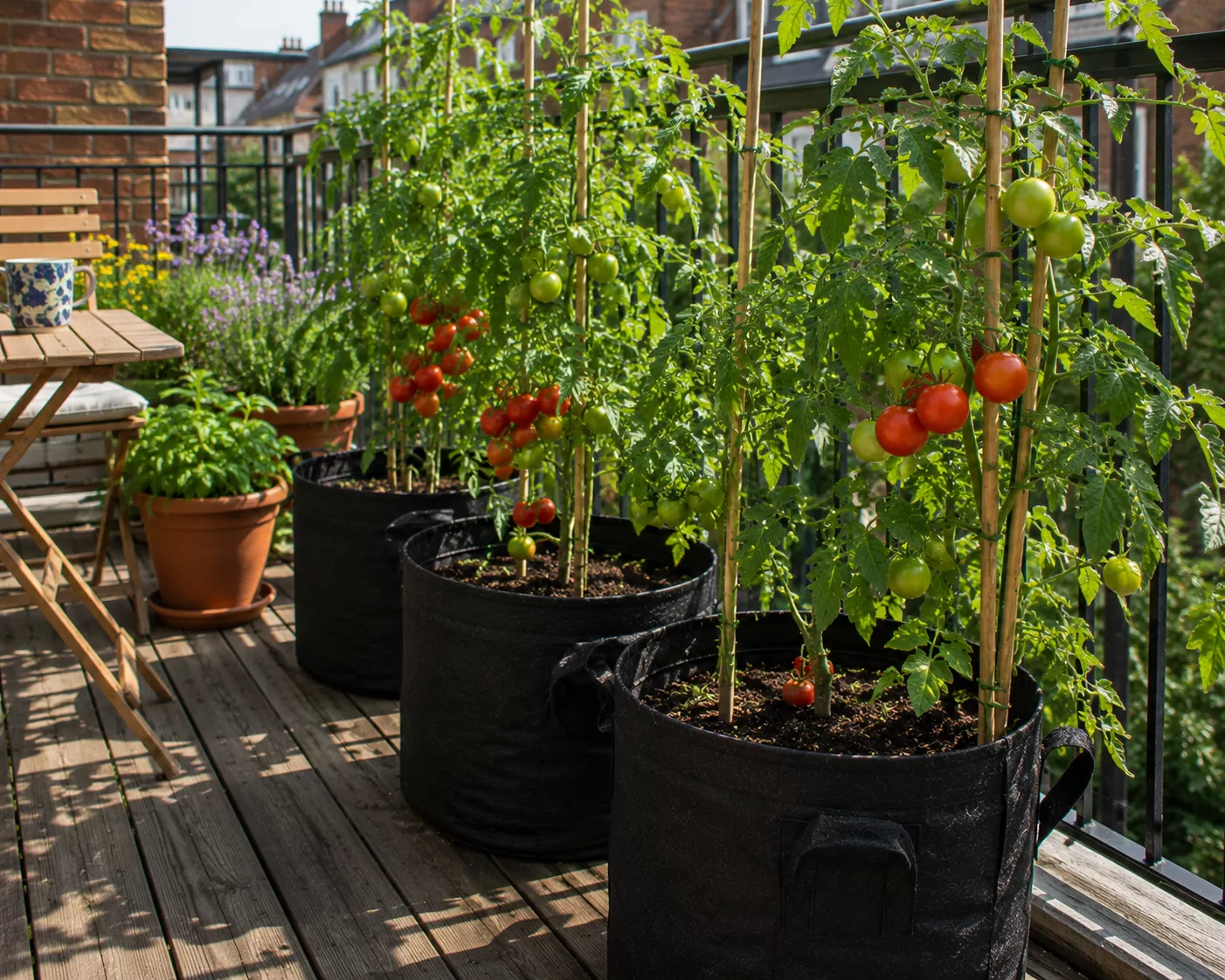
Grow bags can work well on balconies if you manage wind, watering, and support.
Grow bags are excellent for balconies, but there are a few extra things to consider.
Balconies can be windy, hot, shaded, or exposed, depending on the direction they face.
For balcony grow bag tomatoes:
- Choose compact varieties
- Use wide, stable grow bags
- Secure supports properly
- Check watering daily
- Avoid very tall plants in windy spots
- Place bags where they get 6 to 8 hours of sun
- Protect plants from strong wind
- Use saucers carefully if water runoff is a problem
Do not let grow bags drain onto neighbours below.
If drainage is an issue, use a tray or saucer, but do not leave the bag sitting in water for long periods.
Compact varieties such as Patio Princess, Tiny Tim, Red Robin, and Tumbling Tom are easier for balcony growing than giant vining tomatoes.
For balconies, the most important things are choosing compact varieties, keeping the bags stable, and checking the compost often during hot weather.
Can You Grow Tomatoes in Supermarket-Style Grow Bags?
In the UK, many gardeners grow tomatoes in long bags of compost sold as tomato grow bags.
These can work, especially in greenhouses and patios.
However, they are often shallow compared with deep fabric grow bags.
If using a long compost grow bag:
- Shake and loosen the compost before planting
- Plant only two or three tomatoes per bag
- Use grow pots or planting rings on top if possible
- Water carefully because shallow bags dry out quickly
- Feed regularly once fruiting begins
- Add strong support outside the bag
Planting rings can help because they give more compost depth around each tomato plant and make watering easier.
For beginners, individual fabric grow bags are often easier because each plant gets its own deeper root space.
Harvesting Tomatoes from Grow Bags
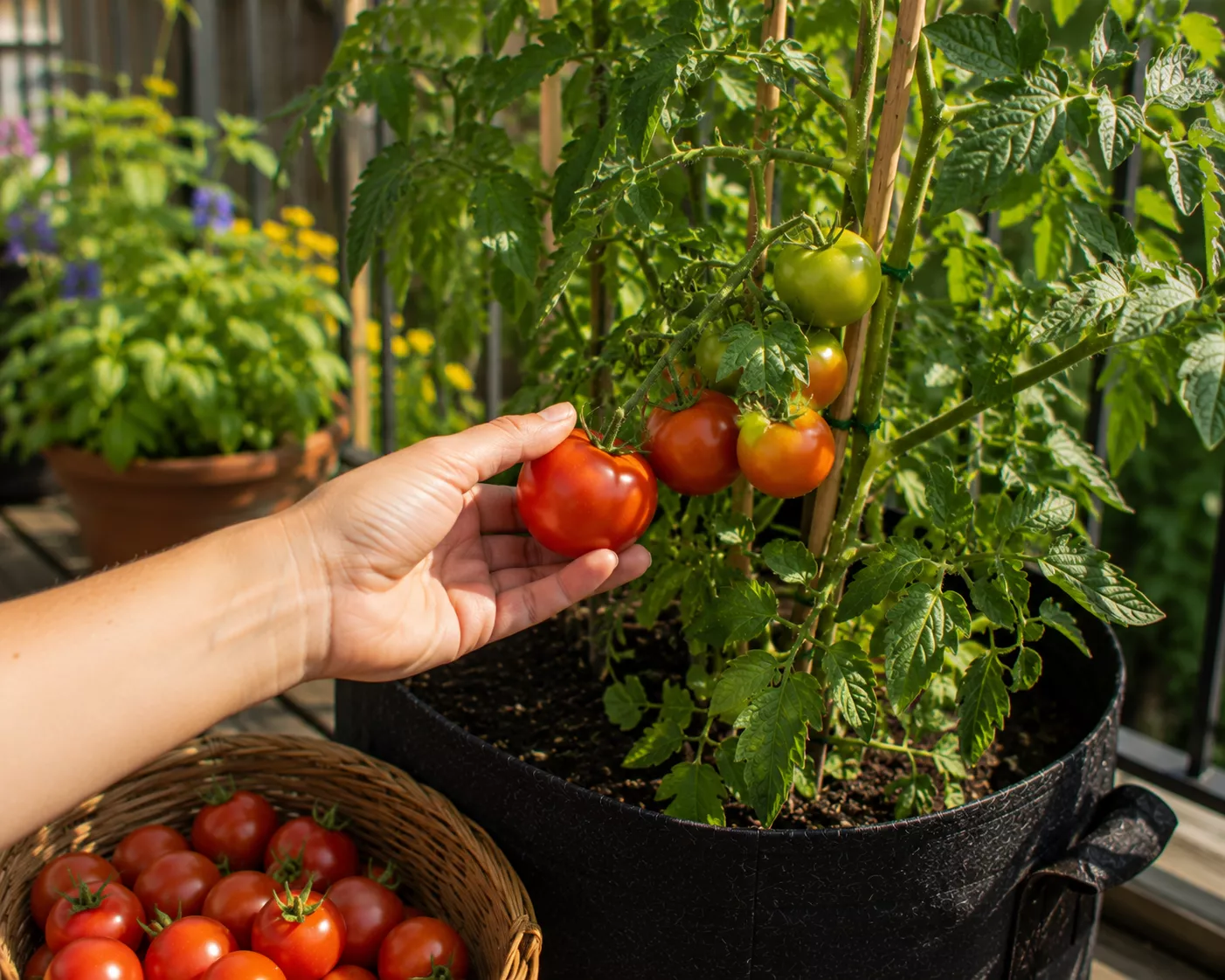
Pick tomatoes when they are fully coloured and slightly firm.
Tomatoes are ready to harvest when they are fully coloured, slightly firm, and come away from the plant with a gentle twist.
Pick regularly once fruit starts ripening.
Regular picking encourages the plant to keep producing and reduces the chance of ripe fruit splitting after rain.
If heavy rain is forecast, pick nearly ripe tomatoes before they split.
If frost is coming, harvest mature green tomatoes and ripen them indoors.
Tomatoes can finish ripening indoors once they reach the breaker stage, when they first begin to show colour.
How to Store Fresh Tomatoes
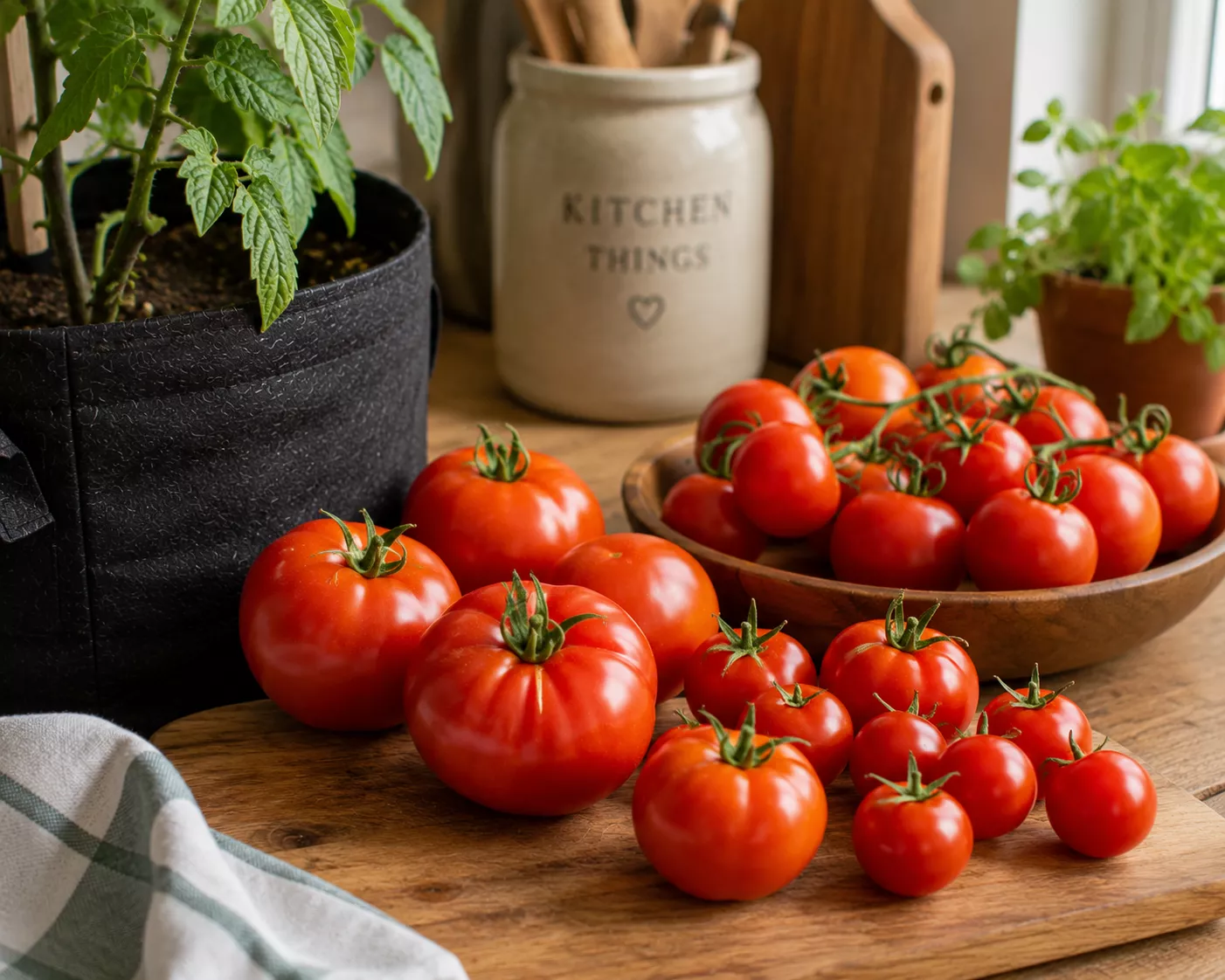
Store homegrown tomatoes at room temperature for the best flavour.
Fresh homegrown tomatoes taste best when stored at room temperature.
Avoid putting whole fresh tomatoes in the fridge unless they are already cut or about to spoil.
Cold temperatures can damage the flavour and texture.
Store tomatoes:
- On the kitchen counter
- Out of direct sunlight
- In a single layer
- Away from strong heat
- With space between fruits if possible
Use ripe tomatoes as soon as possible for the best flavour.
That first tomato from a grow bag, sliced onto bread with a little salt, is one of the best rewards of growing your own food.
Reusing Grow Bags and Compost
At the end of the season, you can clean and reuse fabric grow bags.
First remove the old tomato plant, roots, and plant debris.
If the plant was healthy, the old compost can be added to flower beds, used around ornamentals, or mixed into general garden soil.
Do not reuse old tomato compost for tomatoes again if the plant had serious disease.
Tomatoes are prone to disease problems, so fresh compost is usually the safest choice each year.
To clean fabric grow bags:
- Empty out the old compost.
- Shake out loose roots and debris.
- Rinse the bag with water.
- Scrub if needed.
- Let it dry fully.
- Store it folded in a dry place.
Some fabric grow bags can be washed, but always check the manufacturer’s instructions.
End-of-Season Tomato Grow Bag Care
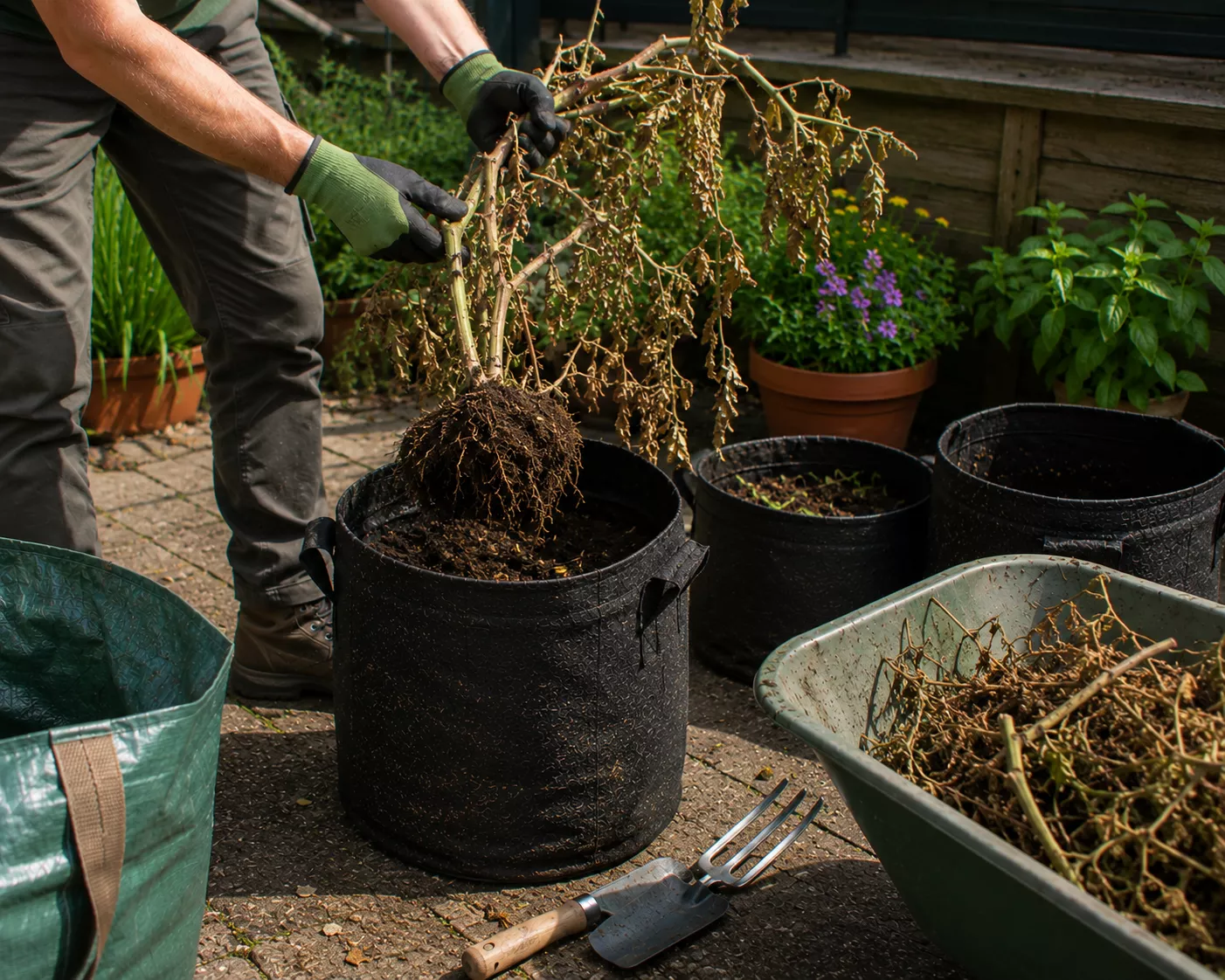
Clean up old plants and bags to reduce disease problems next year.
At the end of the growing season, clear everything properly.
Good cleanup helps reduce pest and disease problems next year.
End-of-season grow bag checklist:
- Make sure the harvest is finished.
- Remove any leftover plant ties, clips, or supports.
- Remove old tomato plants.
- Dispose of diseased plants in the rubbish.
- Compost only healthy plant material.
- Empty or refresh the old compost.
- Clean grow bags.
- Wash stakes, cages, and clips.
- Store bags dry.
- Plan fresh compost for next year.
Do not leave old diseased tomato leaves lying around. They can carry problems into the next season.
Quick Grow Bag Tomato Growing Checklist
Use this simple checklist when growing tomatoes in grow bags:
- Choose a sunny spot with 6 to 8+ hours of direct sunlight.
- Use fabric grow bags where possible.
- Choose at least a 7 to 10 gallon bag for most bush tomatoes.
- Use 15 to 20 gallons for large vining tomatoes.
- Grow one tomato plant per bag for best results.
- Fill with good-quality potting mix, not garden soil.
- Add compost and slow-release fertiliser before planting.
- Harden off plants before moving them outside.
- Plant after frost risk has passed.
- Bury part of the tomato stem deeply.
- Add support at planting time.
- Water consistently and check compost often.
- Use the finger test before watering.
- Water at the base, not over the leaves.
- Mulch the top of the grow bag.
- Feed with tomato feed once fruit starts forming.
- Prune indeterminate tomatoes.
- Remove lower leaves for airflow.
- Help pollination by gently shaking flowers in still areas.
- Watch for blossom end rot, splitting, yellow leaves, and pests.
- Harvest tomatoes when fully coloured and firm.
Frequently Asked Questions About Growing Tomatoes in Grow Bags
What size grow bag is best for tomatoes?
For most tomatoes, a 7 to 10 gallon grow bag is a good minimum. For larger indeterminate or beefsteak tomatoes, use a 15 to 20 gallon grow bag if possible.
Small dwarf tomatoes can grow in smaller bags, but bigger bags usually give better results because they hold more compost, water, and nutrients.
How many tomato plants can you put in one grow bag?
For individual fabric grow bags, grow one tomato plant per bag.
This gives the plant enough root space and makes watering, feeding, pruning, and support much easier.
In long supermarket-style compost grow bags, you can usually grow two or three tomato plants, but they will need careful watering and feeding.
Do tomatoes grow well in grow bags?
Yes, tomatoes can grow very well in grow bags when they have enough sun, compost, water, food, and support.
Grow bags are especially good for patios, balconies, driveways, greenhouses, and small gardens.
The main thing to remember is that grow bags dry out faster than many pots, so regular watering is essential.
Are fabric grow bags better than plastic pots for tomatoes?
Fabric grow bags have excellent drainage and allow air into the root zone. This can encourage healthier root growth and reduce root circling.
Plastic pots hold moisture for longer and can be more stable in windy areas.
Both can work well. Grow bags are excellent if you can keep up with watering.
What is the best soil for tomatoes in grow bags?
Use a good-quality potting mix or multipurpose compost. Do not use heavy garden soil.
A simple mix is:
- 2 parts potting mix or multipurpose compost
- 1 part compost or well-rotted manure
- 1 part perlite, fine bark, or coarse compost for structure
The mix should hold moisture but still drain well.
How often should I water tomatoes in grow bags?
Check the compost daily in warm weather.
Use the finger test. Push your finger about 2 inches into the compost. If it feels dry, water deeply.
In hot weather, tomatoes in grow bags may need watering every day, and sometimes twice a day.
Why are my grow bag tomatoes splitting?
Tomatoes often split when the plant gets a sudden rush of water after the compost has been dry.
Keep watering consistent, mulch the grow bag, and pick ripe fruit before heavy rain.
Why are my grow bag tomatoes getting blossom end rot?
Blossom end rot is usually linked to inconsistent watering. If the grow bag dries out, the plant struggles to move calcium to the fruit.
Keep the compost evenly moist, use a large enough grow bag, mulch the surface, and avoid overfeeding with nitrogen.
Do I need to feed tomatoes in grow bags?
Yes. Tomatoes in grow bags need regular feeding because the compost volume is limited and nutrients can wash out with watering.
Start feeding with a tomato feed once the first small fruits begin to form. Feed every 1 to 2 weeks, following the product instructions.
Can I reuse grow bags next year?
Yes, fabric grow bags can usually be reused if they are cleaned and dried properly.
However, it is best to use fresh compost for tomatoes each year, especially if your plants had disease problems.
Old compost from healthy plants can be used around flowers, shrubs, or non-tomato crops.
Final Thoughts
Growing tomatoes in grow bags is a brilliant way to enjoy homegrown tomatoes without needing a big garden.
The setup is simple, the cost is usually low, and you can grow tomatoes on a patio, balcony, driveway, greenhouse, or small sunny corner.
The secret is consistency.
Choose a large enough grow bag, use good potting mix, plant deeply, support the plant early, water regularly, and feed once fruit starts forming.
If you do those basics well, a simple grow bag can become a very productive little tomato garden.
And when you pick your first warm, ripe tomato from a plant you grew yourself, you will understand why grow bag gardening is worth it.
Happy growing!