How to Grow Tomatoes Indoors: A Simple Beginner's Guide
Growing tomatoes indoors is completely possible, but there is one important difference between growing them inside and growing them outdoors: indoors, you have to provide the conditions that nature normally supplies for you.
Tomato plants need strong light, warm temperatures, enough root space, regular water and nutrients, moving air, and a little help with pollination. If one of those things is missing—especially light—the plant may survive indoors without producing many tomatoes.
The easiest way to succeed is to choose a compact tomato variety, grow it in a well-drained container, place it under a strong grow light, and keep the potting mix evenly moist.
With the right setup, you can grow tomatoes indoors even when you do not have a garden, balcony, greenhouse, or suitable outdoor growing season.
Contents
- Quick Answer: How Do You Grow Tomatoes Indoors?
- Can You Really Grow Tomatoes Indoors?
- Choose the Right Tomato Variety for Indoors
- Determinate vs Indeterminate Tomatoes Indoors
- Indoor Tomatoes Need Plenty of Light
- What Grow Light Is Best for Indoor Tomatoes?
- Keep Indoor Tomatoes Warm
- Give the Plants Some Airflow
- Choose the Right Container
- Use Potting Mix, Not Garden Soil
- How to Start Indoor Tomatoes from Seed
- Can You Start with a Young Tomato Plant Instead?
- How to Water Tomatoes Indoors
- How to Feed Indoor Tomato Plants
- Indoor Tomato Flowers Need Help with Pollination
- Support the Plant Before It Gets Heavy
- Should You Prune Indoor Tomato Plants?
- How to Keep an Indoor Tomato Plant Compact
- Common Problems When Growing Tomatoes Indoors
- How Long Do Indoor Tomatoes Take to Produce Fruit?
- When to Harvest Indoor Tomatoes
- Can You Grow Tomatoes Indoors All Year?
- A Simple Indoor Tomato Setup for Beginners
- Indoor Tomato Growing Checklist
- Frequently Asked Questions
- Do tomatoes grow well indoors?
- Do indoor tomatoes need a grow light?
- How many hours of light do indoor tomatoes need?
- What is the best tomato for indoor growing?
- What size pot does an indoor tomato need?
- Do you need to hand-pollinate indoor tomatoes?
- Can I grow tomatoes indoors in winter?
- Why is my indoor tomato flowering but not producing fruit?
- Final Thoughts
Quick Answer: How Do You Grow Tomatoes Indoors?
Quick answer: Choose a dwarf, micro-dwarf, patio, or other compact tomato variety. Give it around 12–16 hours of strong light each day, keep it warm, grow it in a container with drainage holes, water when the top 2–3 cm (about 1 inch) of potting mix feels dry, feed regularly once it is established, and gently shake the flowers to help pollination.
Can You Really Grow Tomatoes Indoors?
Yes. Tomatoes can grow, flower, and produce ripe fruit indoors.
The challenge is not keeping a tomato plant alive. The challenge is giving it enough energy to produce a worthwhile crop.
Outdoors, tomatoes receive intense sunlight for many hours, natural airflow, changing temperatures, rain or irrigation, and vibration from wind and insects. Indoors, those conditions are weaker or completely absent.
That means you normally need to replace them with:
- a strong sunny window and, in many cases, a grow light
- a suitable container and potting mix
- regular watering and feeding
- gentle airflow from a fan
- support for the stems
- manual vibration of flowers to improve pollination
Once you understand those requirements, indoor tomato growing becomes much easier.
Choose the Right Tomato Variety for Indoors
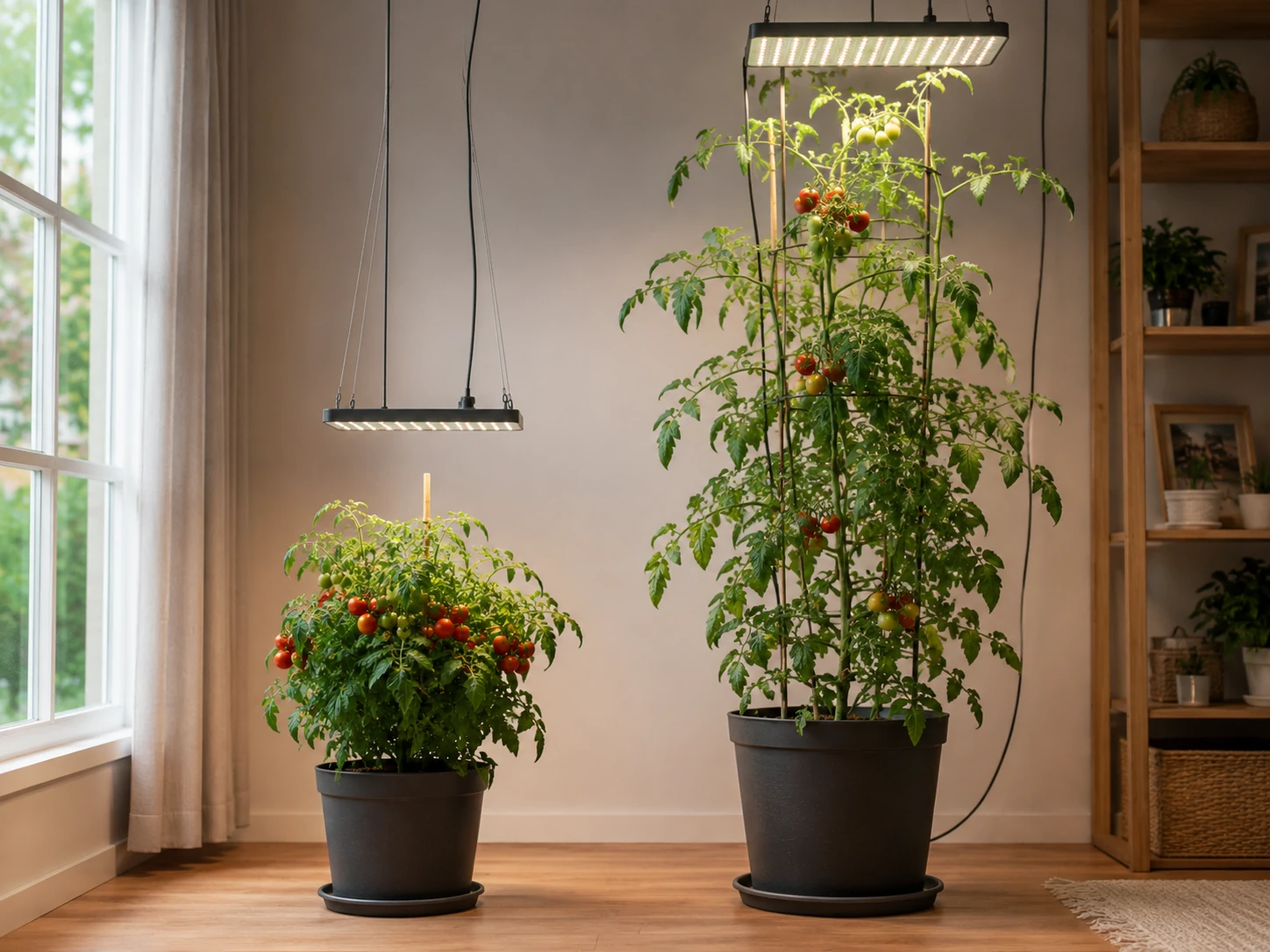
Compact tomato varieties are usually much easier to manage indoors than tall indeterminate vines.
Choosing the right variety is one of the most important decisions you can make.
Almost any tomato can technically be grown in a container indoors, but that does not mean every variety is practical.
Large indeterminate tomatoes can continue growing for many months and may become several feet tall. They need strong support, powerful lighting, regular pruning, and considerably more space.
For most homes, dwarf, micro-dwarf, patio, and compact determinate tomatoes are much easier.
Good types of tomatoes for indoor growing
Look for seed packets or plants described as:
- dwarf
- micro-dwarf
- patio
- compact
- bush
- container tomato
- determinate
These plants usually stay shorter and are easier to position beneath a grow light.
Indoor-friendly tomato varieties
Examples commonly grown in small spaces include:
- Tiny Tim – a compact cherry tomato that stays much smaller than a standard tomato plant
- Red Robin – a very small cherry tomato suitable for containers
- Micro Tom – an extremely compact variety for very limited spaces
- Tumbling Tom – a trailing tomato that can work well in hanging containers or on raised shelves
- Patio-type tomatoes – compact varieties bred specifically for containers and small spaces
Availability differs between countries, so do not worry if you cannot find those exact names. The important thing is the growth habit.
A healthy compact tomato that fits beneath your lights will usually be a much better indoor plant than a vigorous variety that quickly outgrows the space.
Determinate vs Indeterminate Tomatoes Indoors
Tomatoes are commonly divided into two growth habits.
Determinate tomatoes
Determinate tomatoes grow to a more limited size and produce much of their crop over a relatively concentrated period.
They are usually the easiest choice indoors because they:
- stay more manageable
- need less vertical space
- require less pruning
- are easier to keep evenly lit
- work well in containers
Many dwarf and patio tomatoes fall into this general group, although individual varieties can behave differently.
Indeterminate tomatoes
Indeterminate tomatoes continue growing and producing new stems, flowers, and fruit as long as conditions remain suitable.
They can be grown indoors, but they require more work. You will normally need:
- a larger container
- more vertical space
- strong support
- larger or multiple grow lights
- regular training
- some pruning to control the plant
If this is your first attempt at growing tomatoes indoors, start with a compact plant. You can always experiment with larger vining varieties later.
Indoor Tomatoes Need Plenty of Light
Light is usually the biggest limiting factor when growing tomatoes indoors.
Tomatoes are high-light plants. A room that seems bright to us may still be far darker than an outdoor garden on a sunny day.
A tomato receiving too little light often becomes:
- tall and thin
- pale green
- weak-stemmed
- stretched toward a window
- slow to flower
- poor at setting and ripening fruit
This stretched growth is often called legginess.
Can you grow tomatoes on a windowsill?
Sometimes, but a window alone is not always enough.
A large, unobstructed, south-facing window can provide useful natural light, especially during brighter months. However, glass reduces light intensity, winter days are short, and nearby buildings, trees, curtains, or cloudy weather can reduce the available light even further.
A sunny window is therefore best treated as useful extra light rather than assuming it will always support heavy fruit production.
For reliable indoor growing, especially through autumn and winter, a grow light is usually the safer choice.
What Grow Light Is Best for Indoor Tomatoes?
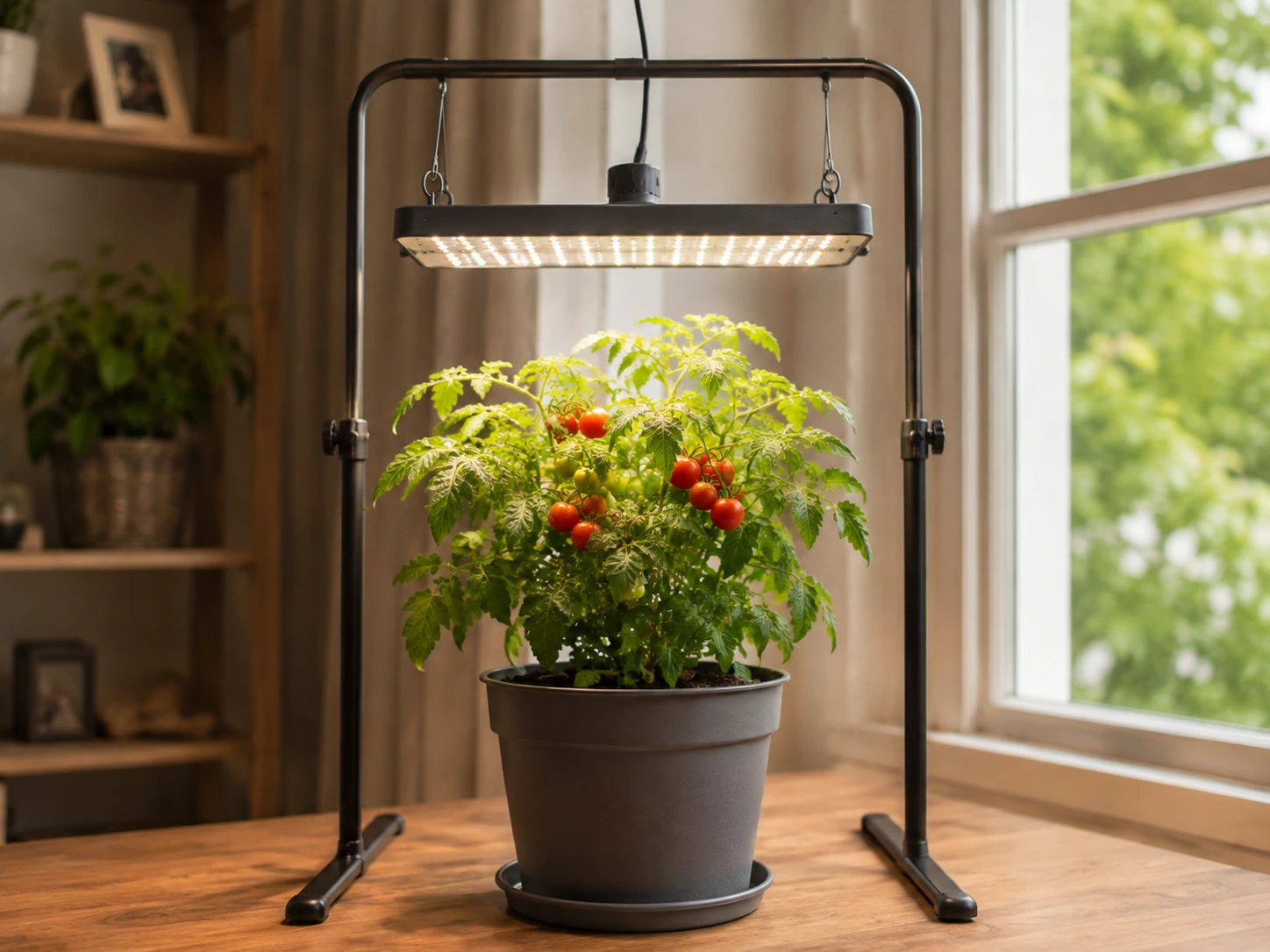
Position the grow light evenly above the canopy and raise it as the tomato plant grows.
LED grow lights are a practical option for most homes because they are energy efficient, widely available, and produce less heat than many older lighting systems.
You do not necessarily need a specialist commercial greenhouse lamp, but the light must be strong enough for fruiting plants rather than only seedlings or decorative houseplants.
When choosing a light, look for one designed for vegetables, flowering plants, or full-cycle plant growth.
How long should grow lights stay on?
A useful starting point is around 12–16 hours of strong light per day.
Tomatoes also benefit from a regular dark period, so do not leave the lights running continuously for 24 hours.
A plug-in timer makes this much easier. For example, you can set the lights to turn on every morning and switch off automatically in the evening.
How close should the light be?
The correct distance depends on the strength and design of the light.
Weak lights may need to sit quite close to the canopy, while stronger fixtures may need more distance to avoid scorching the leaves.
Follow the manufacturer’s recommended hanging height if one is provided.
Then watch the plant:
- If it stretches upward and becomes leggy, it probably needs stronger or closer light.
- If upper leaves bleach, curl, or scorch, the light may be too intense or too close.
- If growth is compact, green, and sturdy, the light level is probably much better.
Raise the fixture as the tomato grows so the top leaves do not grow into it.
Keep Indoor Tomatoes Warm
Tomatoes prefer warm conditions.
A practical indoor range is roughly 18–27°C (65–80°F) for active growth, with slightly cooler nights usually being fine.
Try to avoid prolonged temperatures below about 13–15°C (55–59°F). Cold conditions can slow growth and interfere with flowering and fruit development.
Very hot rooms can also cause problems. If temperatures stay around 32°C (90°F) or higher, flowers may fail to set fruit properly.
Keep tomato plants away from:
- cold draughts
- frequently opened exterior doors
- very cold windows at night
- direct blasts from radiators or heaters
- hot, dry heating vents
A fairly stable room temperature is usually easier for indoor tomatoes than repeated swings between very hot and very cold conditions.
Give the Plants Some Airflow
Outdoor tomato plants are constantly moved by air. Indoors, the air around a plant can remain almost completely still.
A small fan can help.
You do not need to blast the plant. A gentle movement of the leaves is enough.
Air circulation can:
- strengthen stems
- reduce stagnant humid air around the foliage
- help leaves dry more quickly
- reduce conditions that favour some fungal problems
- help move flowers slightly for pollination
Run a small fan nearby for part of the day or use a low setting if the room is very still.
Do not point a powerful fan directly at the plant from close range, as this can dry the potting mix and foliage unnecessarily quickly.
Choose the Right Container
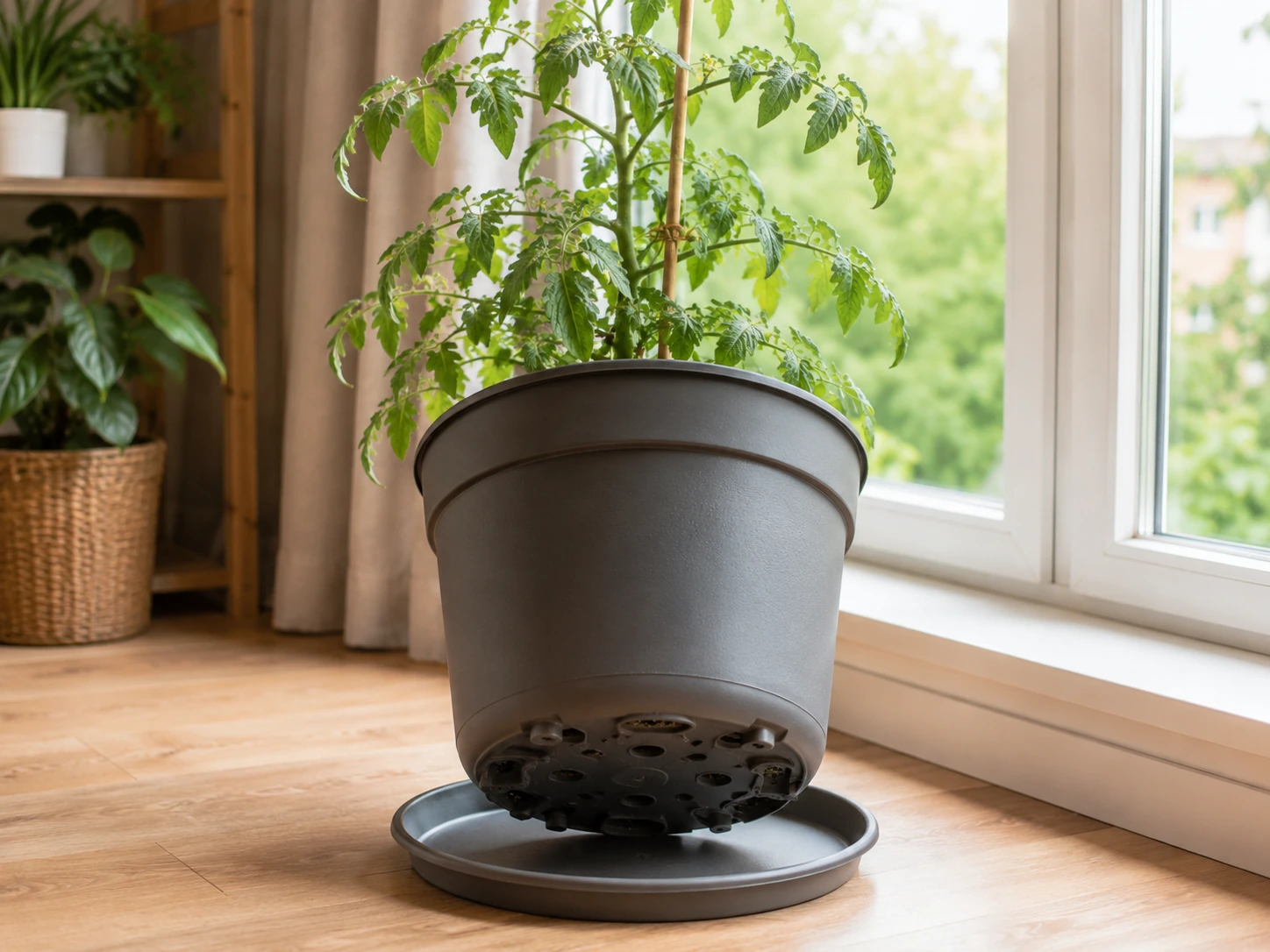
Use a generously sized container with drainage holes and a saucer to protect indoor surfaces.
Tomatoes need more root space than many common houseplants.
Tiny micro-dwarf tomatoes can grow in relatively small containers, but standard compact tomatoes are much easier to manage when they have a generous volume of potting mix.
For most ordinary container tomato plants, around 20–30 litres (5–8 US gallons) is a useful starting point. Larger indeterminate plants are easier to manage in 30–40 litres or more.
The exact size depends on the variety.
A larger pot generally gives you:
- more room for roots
- a larger water reserve
- more stable moisture
- more available nutrients
- less risk of the plant becoming root-bound quickly
If you are unsure what size or material to use, our guide to the best pots for tomato plants explains container size, drainage, materials, and self-watering options in more detail.
Drainage holes are essential
Never grow a tomato in a decorative indoor pot with no way for excess water to escape.
The container should have drainage holes in the bottom and a tray or saucer underneath to protect your floor or furniture.
Water should be able to move through the root zone and drain away rather than collecting around the roots.
If water remains in the saucer after watering, empty it rather than leaving the pot standing in water for long periods.
Use Potting Mix, Not Garden Soil
Indoor containers need a light, well-aerated growing medium.
Garden soil is usually a poor choice in pots because it can become heavy and compacted. It can also bring weeds, insects, or soil-borne organisms into the house.
Instead, use a good-quality potting mix, potting compost, container compost, or tomato compost.
The ideal mix should:
- hold enough moisture for the roots
- drain excess water freely
- contain plenty of air spaces
- resist becoming hard and compacted
- provide or hold nutrients well
You do not need an elaborate homemade recipe to start successfully. A good commercial potting mix is usually much easier for beginners.
For a detailed explanation of compost, drainage, pH, and homemade mixes, see our guide to the best soil for tomatoes in pots.
How to Start Indoor Tomatoes from Seed
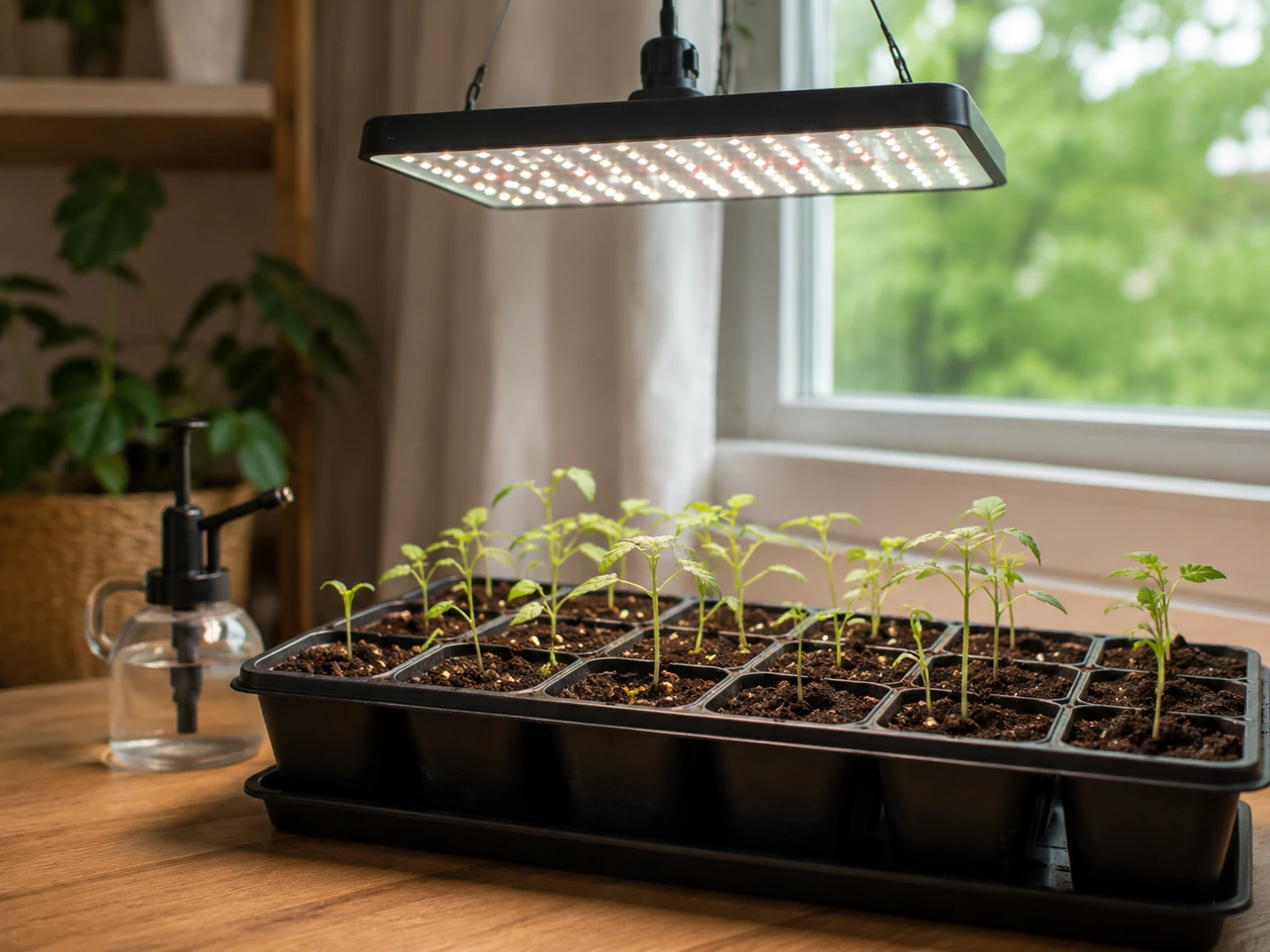
Give tomato seedlings strong light as soon as they emerge so they grow compact and sturdy rather than leggy.
Starting from seed gives you the widest choice of compact varieties.
You will need:
- tomato seeds
- small pots, modules, or a seed tray
- seed-starting compost or fine potting mix
- water
- warmth
- strong light once seedlings emerge
Step 1: Sow the seeds
Fill your seed tray or small pots with seed-starting mix and moisten it.
Sow tomato seeds about 6 mm (1/4 inch) deep, then cover them lightly.
Keep the mix moist but not waterlogged.
Step 2: Keep them warm for germination
Tomato seeds germinate best in warm conditions.
A room around 21–27°C (70–80°F) usually works well. A seedling heat mat can help in a cool house, but it is not essential if the room is already warm.
Step 3: Give seedlings strong light immediately
As soon as the seedlings emerge, move them into strong light.
This is important because tomato seedlings stretch very quickly when light is weak.
If you are using a grow light, position it according to the manufacturer’s recommendations and adjust it as the seedlings grow.
Step 4: Pot them on
Once the seedlings have developed true leaves and are growing strongly, move them into larger pots as needed.
Tomatoes can produce additional roots from buried sections of stem. When transplanting a leggy seedling, you can therefore plant it somewhat deeper than it was growing before, provided you remove any leaves that would otherwise be buried.
Eventually, move the plant into its final container before it becomes badly root-bound.
Can You Start with a Young Tomato Plant Instead?
Absolutely.
Buying a compact young tomato plant is the quickest option if you do not want to start from seed.
Check the label before buying. A plant sold simply as a “tomato” may eventually become much larger than expected.
Look for words such as dwarf, patio, bush, compact, determinate, or container tomato.
Inspect the plant before bringing it indoors. Avoid plants with obvious pests, sticky leaves, extensive yellowing, or damaged growing tips.
Introducing pests on a new plant is much easier than removing them from a collection of indoor plants later.
How to Water Tomatoes Indoors
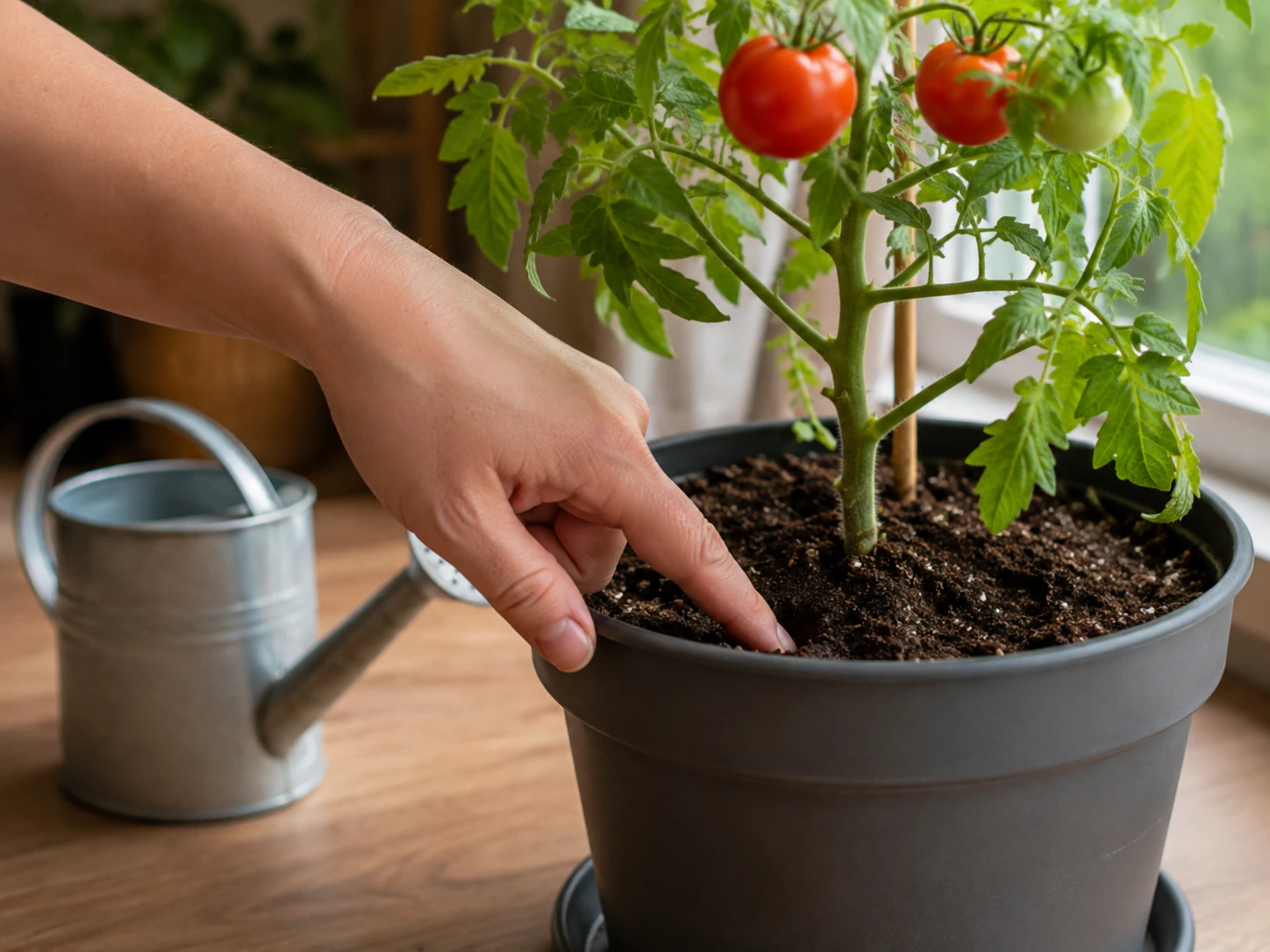
Push a finger about 2–3 cm into the potting mix and water when it feels dry at that depth.
Indoor tomatoes need consistent moisture, but they should not sit in permanently wet compost.
The easiest method is to check the potting mix rather than watering on a fixed schedule.
Push your finger about 2–3 cm (roughly 1 inch) into the mix.
- If it feels dry at that depth, water the plant.
- If it still feels cool and moist, check again later.
- If it feels wet or soggy, wait.
When watering, apply water slowly across the surface until a small amount begins to drain from the bottom of the pot.
This helps wet the whole root zone rather than only the top layer.
Try to keep moisture reasonably even. Repeatedly allowing the pot to become extremely dry and then soaking it can stress the plant and contribute to problems such as fruit splitting and blossom end rot.
Indoor conditions vary enormously, so there is no reliable rule such as “water every two days.” A plant near a warm window under strong lights may dry much faster than one in a cooler room.
Our full guide on how often to water tomatoes in pots explains how to judge moisture and adjust watering as the plant grows.
How to Feed Indoor Tomato Plants
Tomatoes use a lot of nutrients, and container-grown plants have access only to what is available inside the pot.
Some fresh potting mixes contain enough fertiliser for the first few weeks. After that, the plant will normally need regular feeding.
The simplest approach is to use a fertiliser labelled for tomatoes or fruiting vegetables and follow the manufacturer’s dosage instructions.
Avoid assuming that more fertiliser means more tomatoes. Overfeeding—especially with high-nitrogen fertiliser—can encourage lots of leafy growth without improving fruit production.
Once flowers begin appearing, a tomato feed formulated for flowering and fruiting plants is usually more suitable than a nitrogen-heavy general-purpose feed.
Always feed moist compost rather than applying strong liquid fertiliser to a completely dry root ball.
Indoor Tomato Flowers Need Help with Pollination
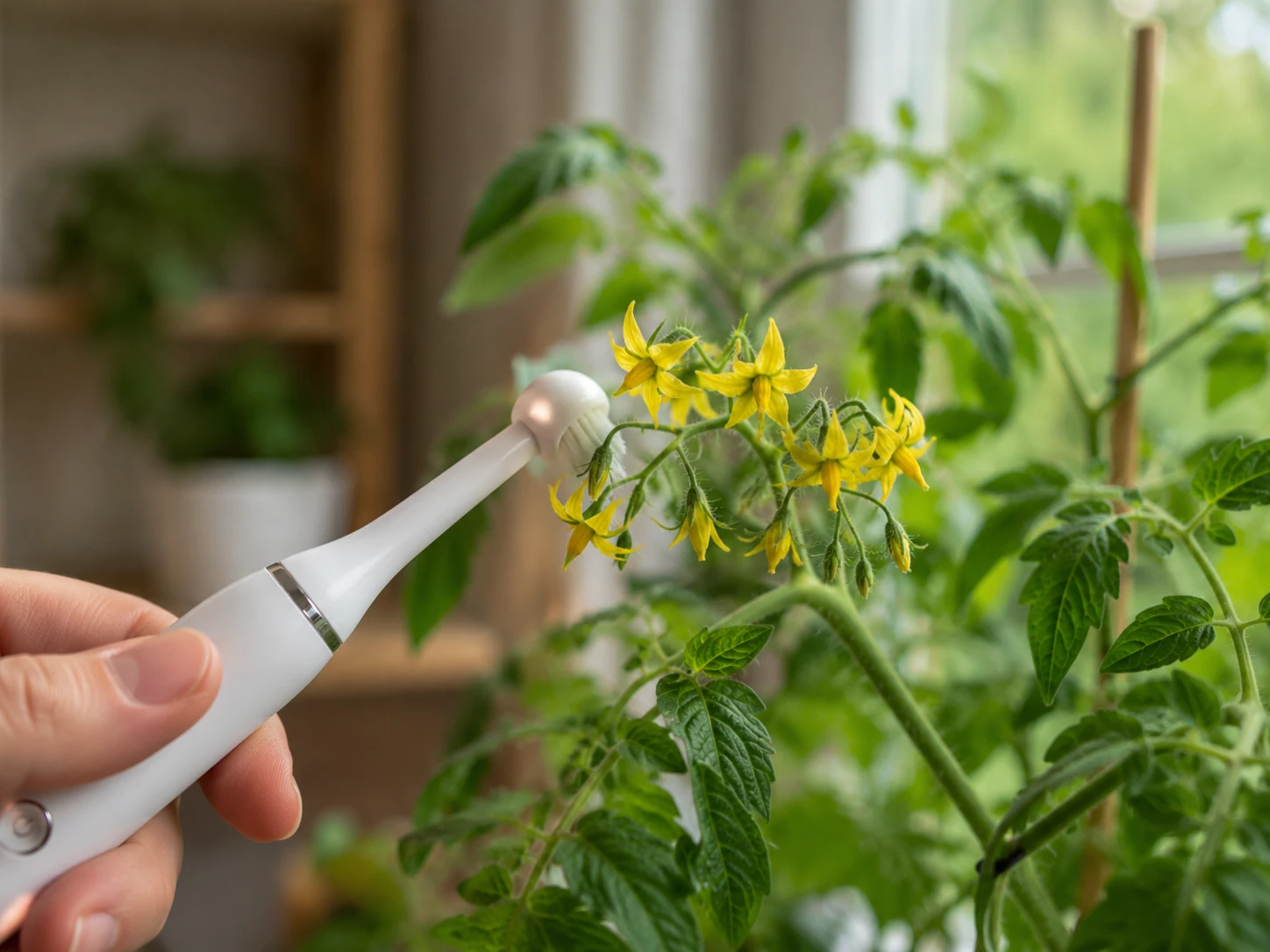
Gently vibrating the flower stem can help release pollen when there is little wind or insect activity indoors.
Tomato flowers contain both male and female reproductive parts, so they are capable of pollinating themselves.
However, pollen still has to move within the flower.
Outdoors, wind and insects help provide the vibration needed to release that pollen. Indoors, the air may be too still for this to happen reliably.
Fortunately, hand pollination is easy.
The simple shake method
When flowers are fully open, gently tap or shake the flower truss for a few seconds.
Do this regularly while the plant is flowering.
You are not trying to knock the flowers off. A light vibration is enough.
Use a fan
Gentle airflow from a small fan can also move the flowers and improve air circulation at the same time.
Use an electric toothbrush
Another method is to hold the vibrating back of an electric toothbrush lightly against the flower stem for a few seconds.
Do not grind the brush into the flower itself. The goal is simply to create vibration.
If your tomato grows well and produces plenty of flowers but almost no fruit, poor pollination is one of the first things to check—along with light and temperature.
Support the Plant Before It Gets Heavy
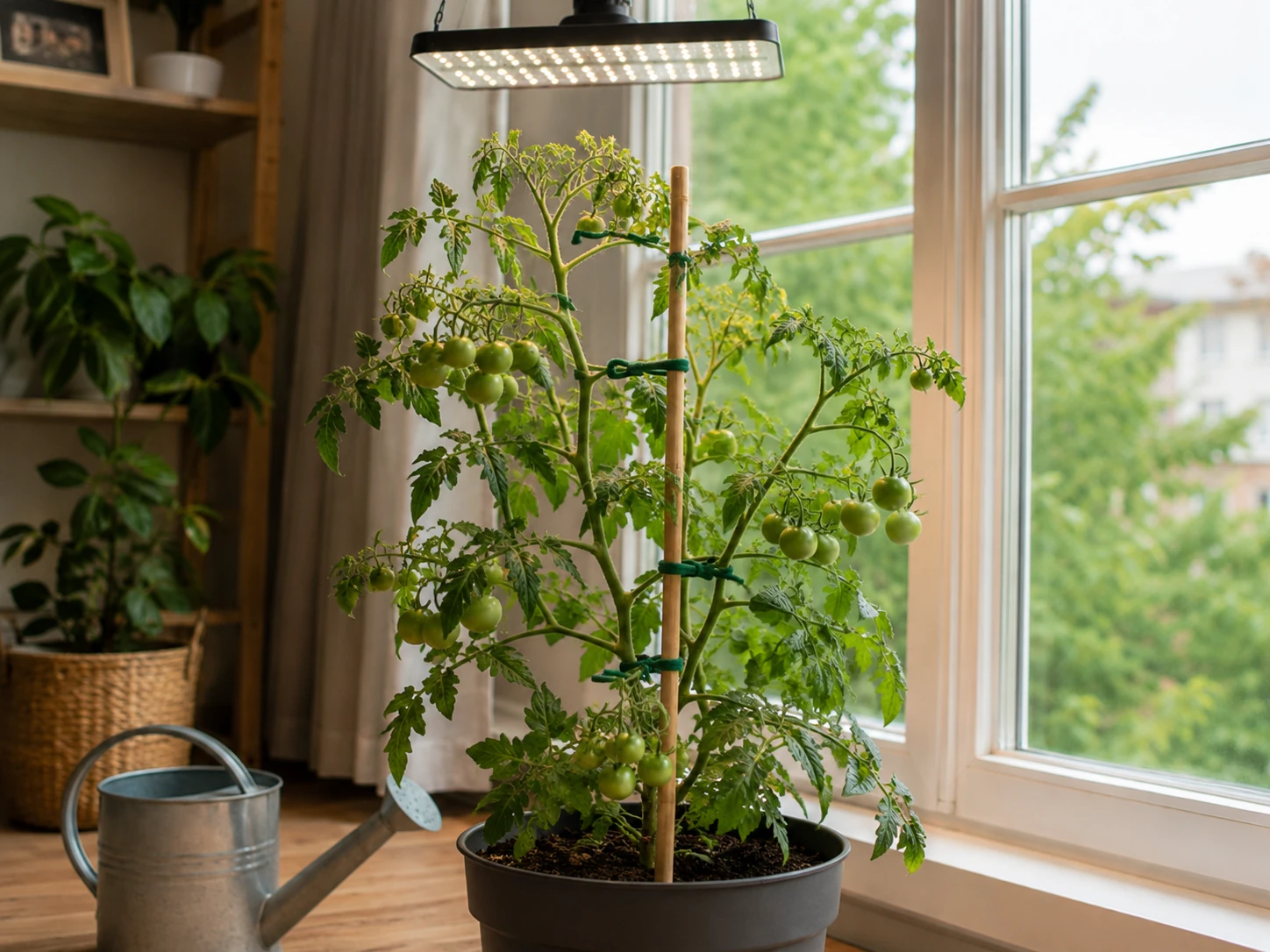
Add support early and use soft, loose ties so developing fruit does not pull the stems over.
Even compact tomatoes can become top-heavy once fruit develops.
Add support early rather than waiting until stems begin bending.
Depending on the variety, you can use:
- a bamboo cane
- a small tomato cage
- soft plant ties
- a vertical string or trellis for taller indeterminate plants
Tie stems loosely so they have room to thicken.
Avoid thin wire or tight knots that can cut into the stem.
Should You Prune Indoor Tomato Plants?
That depends on the variety.
Compact and determinate tomatoes
Do not aggressively remove suckers from compact determinate plants.
Because these plants are naturally limited in size, removing too many shoots can also remove future flowers and reduce the crop.
For most compact indoor tomatoes, pruning should mainly involve removing:
- yellow leaves
- damaged leaves
- diseased-looking foliage
- leaves resting directly on wet potting mix
Indeterminate tomatoes
Indeterminate plants usually need more training.
You can remove selected suckers—the shoots that appear where a leaf joins the main stem—to control the plant’s size and keep growth within the available lighted area.
The goal indoors is not to strip the plant bare. It is to maintain a manageable structure with good light and airflow.
How to Keep an Indoor Tomato Plant Compact
Space is often more limited indoors than light.
A few habits can keep the plant easier to manage:
- Start with a naturally compact variety.
- Keep the grow light strong enough to prevent stretching.
- Rotate the pot occasionally if natural window light comes mainly from one direction.
- Support stems before they flop outward.
- Train indeterminate vines vertically rather than allowing them to sprawl.
- Remove only the pruning growth appropriate for that variety.
Trying to control a naturally huge tomato by constant heavy pruning is much harder than simply choosing a compact cultivar at the beginning.
Common Problems When Growing Tomatoes Indoors
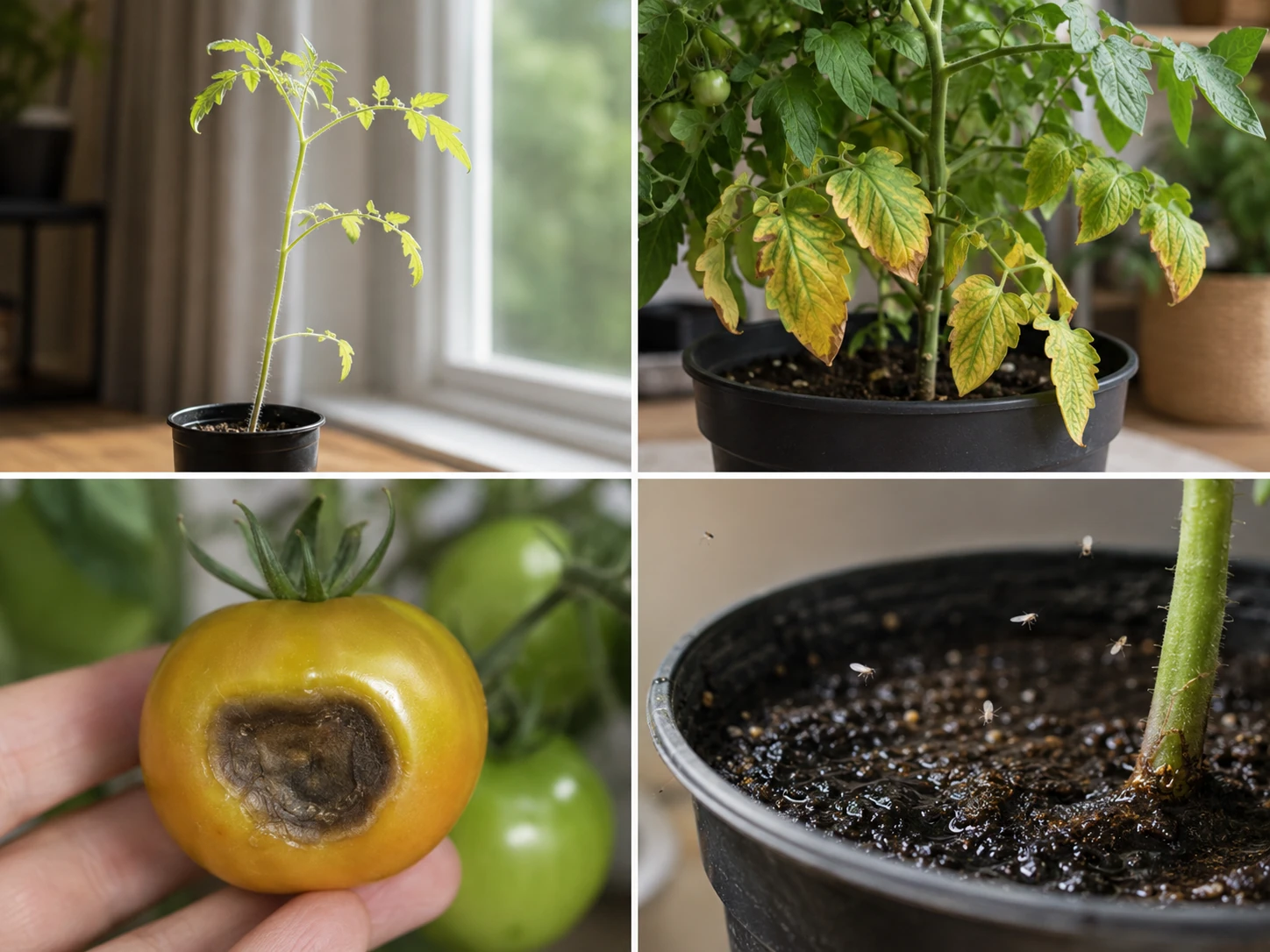
Low light, yellowing leaves, blossom end rot and fungus gnats are some of the problems indoor tomato growers may encounter.
Indoor tomatoes avoid some outdoor problems, but they are not completely pest- or disease-free.
Leggy growth
Likely cause: Not enough light.
Move the plant closer to an appropriate grow light, increase light intensity if possible, or upgrade to a stronger fixture.
Lots of leaves but no flowers
Possible causes: Weak light, excessive nitrogen, or a plant that is still immature.
Make sure the plant receives strong light and avoid overfeeding with nitrogen-heavy fertiliser.
Flowers fall off without producing tomatoes
Possible causes: Temperature stress, weak light, dry conditions, or poor pollination.
Check the temperature, watering, and light level, then gently vibrate open flowers regularly.
Yellow leaves
Yellow leaves can have several causes, including overwatering, poor drainage, nutrient problems, natural ageing of lower leaves, or root stress.
Do not automatically add fertiliser. First check whether the potting mix is staying wet for too long and whether the container drains properly.
Blossom end rot
Blossom end rot appears as a dark, sunken patch at the blossom end of developing fruit.
Irregular water availability is a common contributor because it interferes with the plant’s ability to move calcium into developing fruit.
Keep moisture more consistent rather than repeatedly allowing the root ball to become extremely dry.
Fruit splitting
Tomatoes can split when they take up water rapidly after a dry period.
Again, more consistent moisture is the best starting point.
Fungus gnats
Small dark flies hovering around the potting mix are often fungus gnats.
They are encouraged by consistently wet growing media.
Allow the surface to dry somewhat between waterings, improve drainage and airflow, and use yellow sticky traps if necessary.
Aphids and whiteflies
Check the undersides of leaves and new growth regularly.
If you find pests early, a small infestation is much easier to manage than one that has spread across several indoor plants.
Isolate badly affected plants while you deal with the problem.
How Long Do Indoor Tomatoes Take to Produce Fruit?
The exact time depends on the variety, temperature, light level, and whether you start from seed or a young plant.
Many compact tomatoes can begin producing ripe fruit within a few months of sowing under good conditions, while slower varieties take longer.
The number printed on a seed packet—often described as “days to maturity”—is useful for comparing varieties, but it should not be treated as an exact countdown indoors.
Weak light or cool temperatures can slow development considerably.
If speed matters, choose a compact early-maturing cherry tomato rather than a large beefsteak variety.
When to Harvest Indoor Tomatoes
Harvest tomatoes when they have developed the mature colour expected for the variety and have begun to soften slightly.
Red tomatoes should normally be evenly red or close to it. Yellow, orange, purple, or other varieties should reach their expected mature colour.
Fruit should come away from the plant with a gentle twist when ready.
You can also pick tomatoes once they have clearly started changing colour and allow them to finish ripening at room temperature. This can be useful if a branch is overloaded or you need to reduce weight on the plant.
Can You Grow Tomatoes Indoors All Year?
Yes, provided you can maintain enough light and warmth.
However, “year-round tomatoes” does not necessarily mean one small tomato plant will produce heavily forever.
Compact determinate plants naturally produce their crop over a more limited period. Once production declines, it is often easier to replace the old plant with a new seedling.
If you want a more continuous indoor supply, consider staggering your planting. Start a new compact tomato before the previous one has completely finished fruiting.
Indeterminate plants can continue producing for much longer under favourable indoor conditions, but they also become much larger and require more pruning, support, light, and root space.
For most beginners, several successive compact plants are easier than maintaining one enormous tomato vine indefinitely.
A Simple Indoor Tomato Setup for Beginners
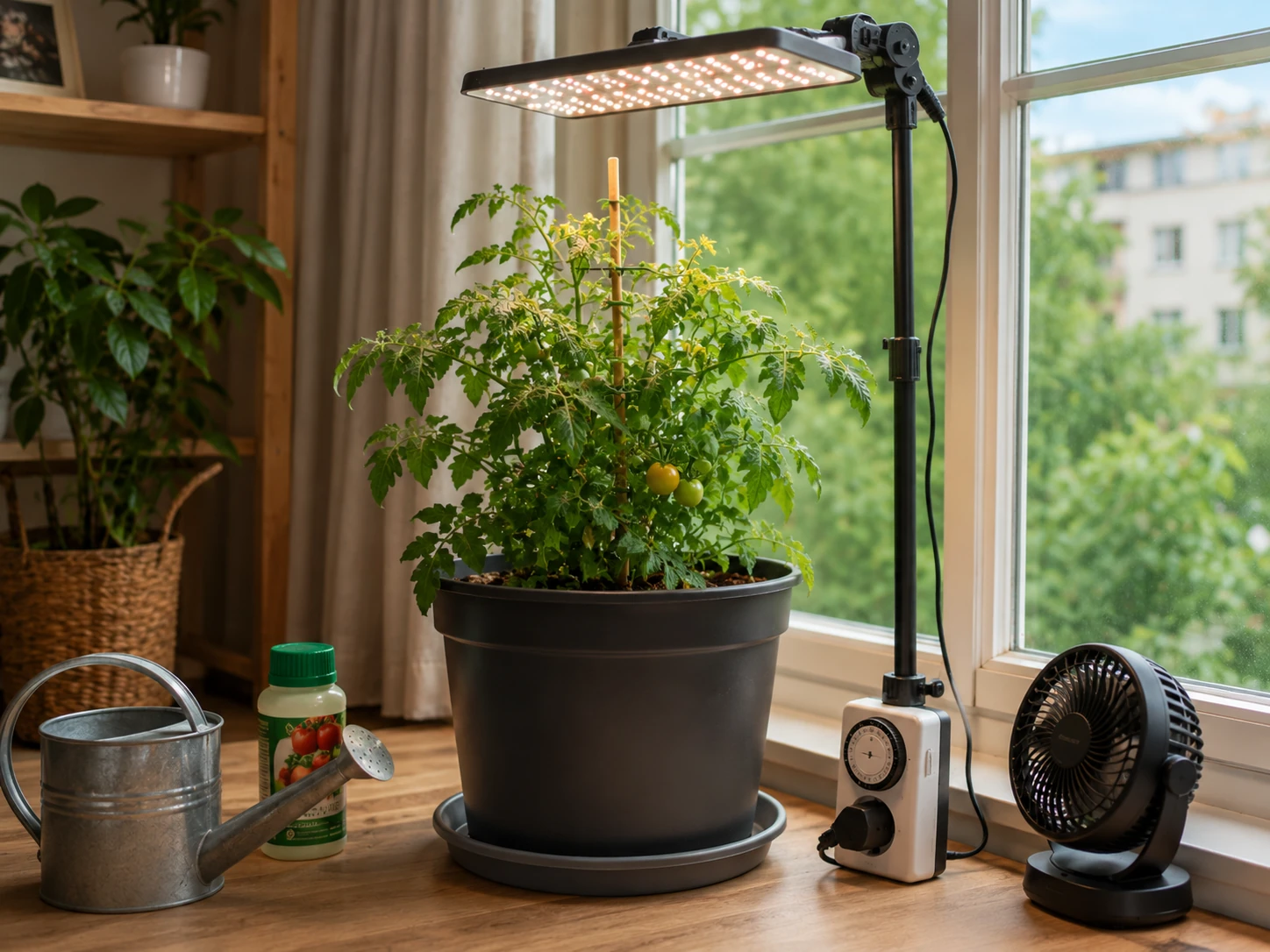
A basic indoor setup can be simple: one compact plant, a large drained pot, a grow light, timer, gentle airflow, support, water and tomato feed.
You do not need to turn an entire room into a greenhouse.
A basic setup can be as simple as:
- one compact tomato plant
- a 20–30 litre container with drainage holes
- good-quality potting mix
- a waterproof saucer or tray
- a strong LED grow light
- a plug-in timer
- a small fan
- a cane or small tomato cage
- tomato fertiliser
Place the plant where accidental water spills will not damage furniture or flooring, and make sure the grow light can be raised as the plant gets taller.
Start with one plant. Once you understand how quickly the pot dries and how much light the plant needs, expanding to several plants becomes much easier.
Indoor Tomato Growing Checklist
For healthy indoor tomatoes, make sure you are providing all of the following:
- Variety: Choose a dwarf, compact, patio, bush, or other manageable tomato.
- Light: Provide around 12–16 hours of strong light each day.
- Temperature: Keep plants warm and away from cold draughts and extreme heat.
- Container: Give roots enough space and make sure drainage holes are present.
- Potting mix: Use a light container mix rather than heavy garden soil.
- Water: Check the compost and water when the upper 2–3 cm feels dry.
- Feeding: Fertilise regularly once the initial nutrients in the potting mix begin running out.
- Airflow: Use gentle air movement around the foliage.
- Pollination: Shake or vibrate open flowers regularly.
- Support: Stake or cage plants before fruit makes the stems heavy.
- Pruning: Prune according to the growth habit rather than treating every tomato the same way.
If one of these elements is missing, fix the basic growing condition before looking for complicated solutions.
Frequently Asked Questions
Do tomatoes grow well indoors?
They can grow very well indoors when they receive enough light, warmth, root space, water, nutrients, and pollination. Light is usually the biggest challenge.
Do indoor tomatoes need a grow light?
Not in every situation, but most indoor tomatoes benefit from one. A very sunny window may support growth during bright months, while winter or low-light rooms usually require supplemental lighting for reliable flowering and fruiting.
How many hours of light do indoor tomatoes need?
Around 12–16 hours of strong light per day is a practical starting point when using grow lights. Give the plant a regular dark period as well.
What is the best tomato for indoor growing?
Dwarf, micro-dwarf, patio, bush, and compact cherry tomatoes are generally the easiest. Tiny Tim, Red Robin, Micro Tom, and Tumbling Tom are examples of compact types often used in small spaces.
What size pot does an indoor tomato need?
Very small micro-dwarf varieties can use smaller containers, but many ordinary compact tomatoes are easier to grow in around 20–30 litres of potting mix. Larger indeterminate varieties usually benefit from 30–40 litres or more.
Do you need to hand-pollinate indoor tomatoes?
You do not need to transfer pollen between separate male and female flowers because tomato flowers are self-fertile. However, gently shaking or vibrating open flowers helps release pollen and can improve fruit set indoors.
Can I grow tomatoes indoors in winter?
Yes, but winter light from a window is often too weak on its own. A strong grow light and a warm indoor location make winter growing much more practical.
Why is my indoor tomato flowering but not producing fruit?
Check the light level, temperature, watering, and pollination. Flowers can fail to set fruit when the plant is stressed, poorly lit, too hot or cold, or not receiving enough vibration to release pollen.
Final Thoughts
Growing tomatoes indoors is not difficult once you understand what the plant is missing compared with an outdoor garden.
The biggest priorities are strong light, a manageable variety, enough root space, consistent moisture, regular feeding, and help with pollination.
For a first indoor crop, keep things simple. Choose one compact cherry or patio tomato, put it in a properly drained container, give it a strong LED grow light on a timer, and learn how quickly the potting mix dries in your room.
Once those basic conditions are right, an indoor tomato plant can flower, set fruit, and give you fresh homegrown tomatoes even when there is no usable growing space outside.