How to Support Tomato Plants: Stakes, Cages and Trellises
Supporting tomato plants keeps stems upright, fruit cleaner and foliage better ventilated. The best method depends mainly on the type of tomato you are growing: tall cordon tomatoes need a strong vertical support, while bush tomatoes usually need a cage, short stake or light frame to stop heavy stems collapsing.
Quick answer: to support tomato plants, install the support at planting time, choose a system strong enough for the mature plant, tie stems loosely with soft ties, and keep adding ties, string or cage guidance as the plant grows. A single cane or string works well for cordon tomatoes. A sturdy cage suits bush tomatoes and many container plants. A stake-and-weave system is useful when you grow several plants in a row.
Contents
- Why tomato plants need support
- Choose support by tomato type
- Best ways to support tomato plants
- How to stake tomato plants step by step
- How to use tomato cages
- How to use a string trellis for cordon tomatoes
- How to use a weave system for rows
- Tying, pruning and ongoing care
- Supporting tomatoes in pots, raised beds and greenhouses
- Common mistakes to avoid
- FAQ
Why tomato plants need support
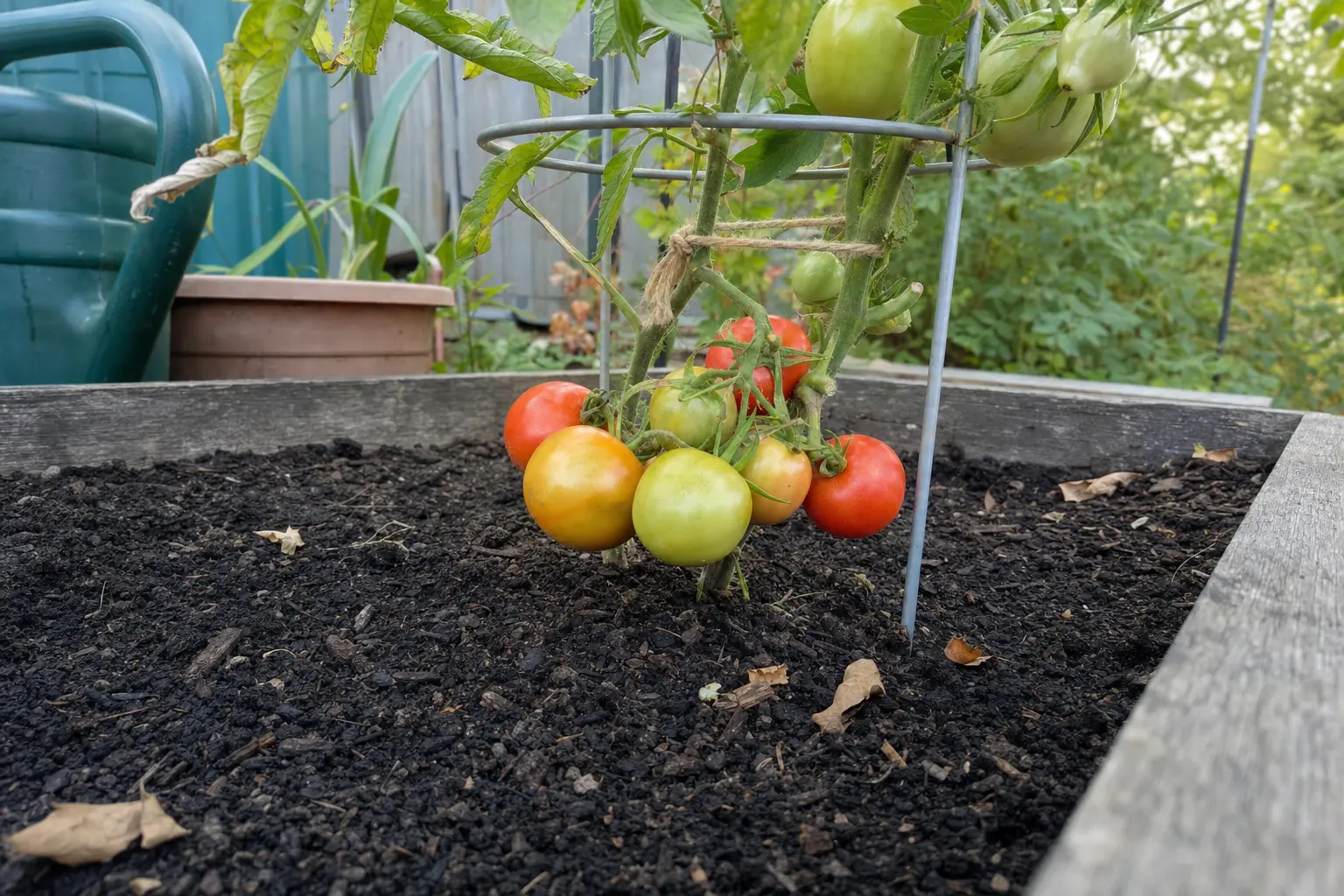
Tomatoes are naturally rather sprawling plants. Without support, stems can flop onto the soil, where fruit is more likely to rot, become damaged by slugs or wildlife, and pick up soil-splashed disease spores during rain or watering.
A good support system helps by:
- keeping leaves and fruit off the ground
- improving airflow around the plant
- making watering, feeding and harvesting easier
- reducing broken stems once fruit becomes heavy
- saving space in small gardens, patios and greenhouses
- helping you spot pests, yellowing leaves and ripening fruit sooner
Support is not only about neatness. A mature tomato plant can become surprisingly heavy, especially when the trusses are full of fruit. Lightweight supports that look fine in May can fail in August, so it is worth planning for the size of the plant at its heaviest.
Choose support by tomato type
Before choosing a cane, cage or trellis, check whether your plant is a cordon or bush tomato. The plant label or seed packet should say this. It may also use the terms indeterminate and determinate.
| Tomato type | Also called | Growth habit | Best support |
|---|---|---|---|
| Cordon | Indeterminate, vine tomato | Keeps growing taller through the season | Tall cane, string trellis, strong stake or overhead support |
| Bush | Determinate | Grows to a more compact, branching shape | Cage, short stakes, low frame or light tying |
| Dwarf or patio | Compact determinate | Short, compact growth, often in pots | Small cage, ring support or short cane if needed |
| Vigorous cherry | Usually indeterminate | Tall and leafy, often very productive | Strong cane, string trellis or large cage |
Cordon tomatoes
Cordon tomatoes are trained as a tall vertical plant, usually with one main stem. They need a strong support from the start and regular tying-in as they grow. Side shoots are normally removed so the plant does not become a tangled mass of stems.
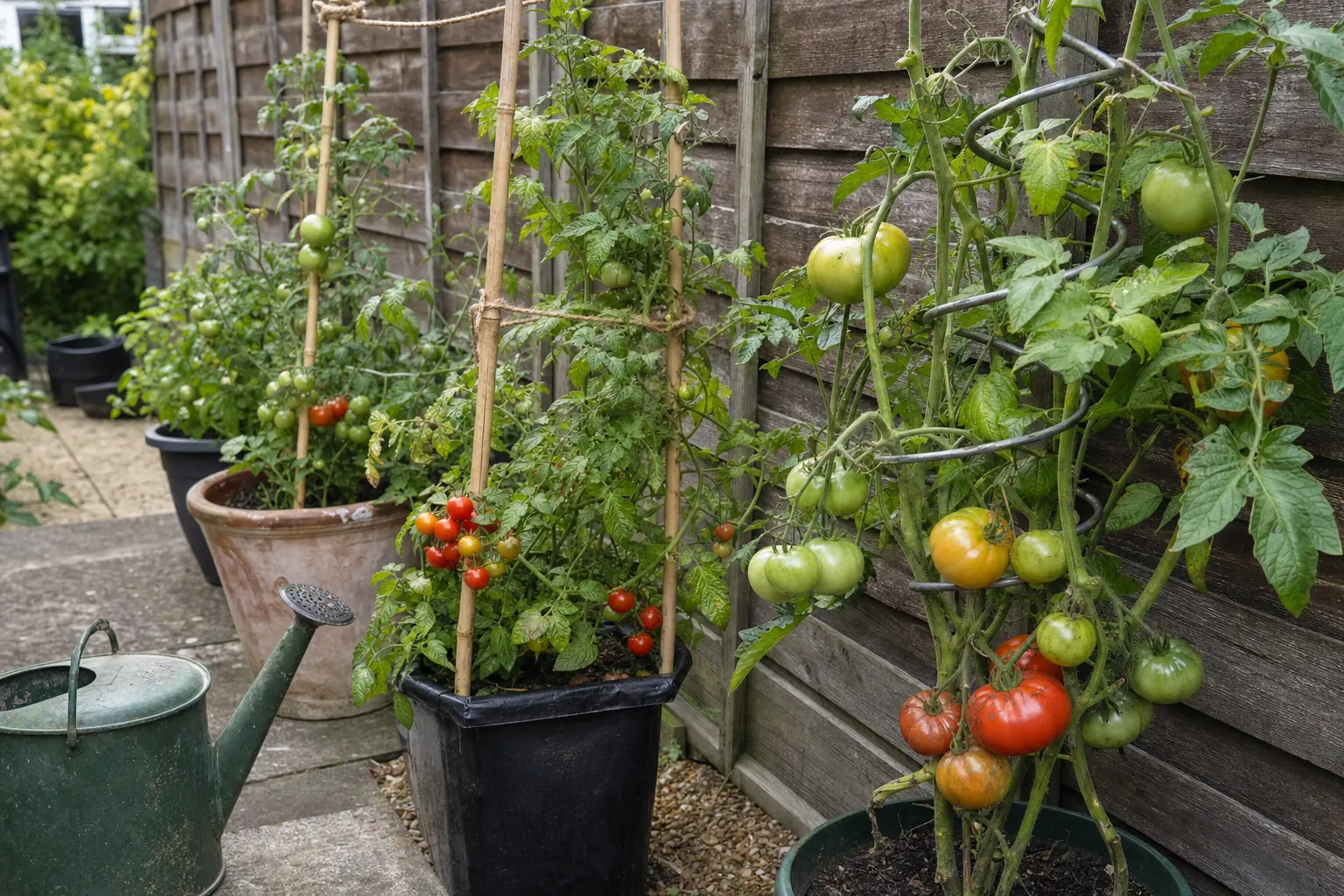
In British gardens and greenhouses, cordons are commonly grown up bamboo canes, strings fixed to an overhead frame, or trellis wires. They are space-efficient, but they do need regular attention.
Bush tomatoes
Bush tomatoes naturally make a compact, branching plant. They are often easier for beginners because they do not usually need side-shoot removal. However, “bush” does not mean “no support at all”. Heavy crops can pull stems down, especially after rain or in windy weather.
For bush tomatoes, use a sturdy cage, several short stakes around the plant, or a simple frame that prevents the branches from sagging onto the compost or soil.
Best ways to support tomato plants
There is no single best tomato support for every garden. Use the method that suits your plant type, space and how much maintenance you want to do.
| Support method | Best for | Main advantage | Watch out for |
|---|---|---|---|
| Single cane or stake | Cordon tomatoes, especially in pots or beds | Simple, cheap and space-saving | Needs regular tying and pruning |
| Tomato cage | Bush tomatoes, patio plants, some vigorous plants if cage is large | Less tying and less pruning | Flimsy cages can topple or bend |
| String trellis | Greenhouse cordons, polytunnels, sheltered beds | Very tidy and excellent for tall plants | Needs a strong overhead frame |
| Stake-and-weave | Several tomatoes in a row | Efficient for rows and productive beds | Less useful for single plants or containers |
| Trellis panel or wires | Sheltered walls, raised beds, greenhouses | Good use of vertical space | Plants still need tying or clipping |
For most beginners, the easiest choices are:
- One tall cane per cordon tomato.
- One strong cage per bush or patio tomato.
- A string trellis in a greenhouse if you have a secure roof bar or frame.
If you are still deciding where to grow your crop, support choice is closely linked with container size and growing space. For container growing, see our guide to growing tomatoes in pots. For open beds, you may also find growing tomatoes in raised beds useful.
How to stake tomato plants step by step
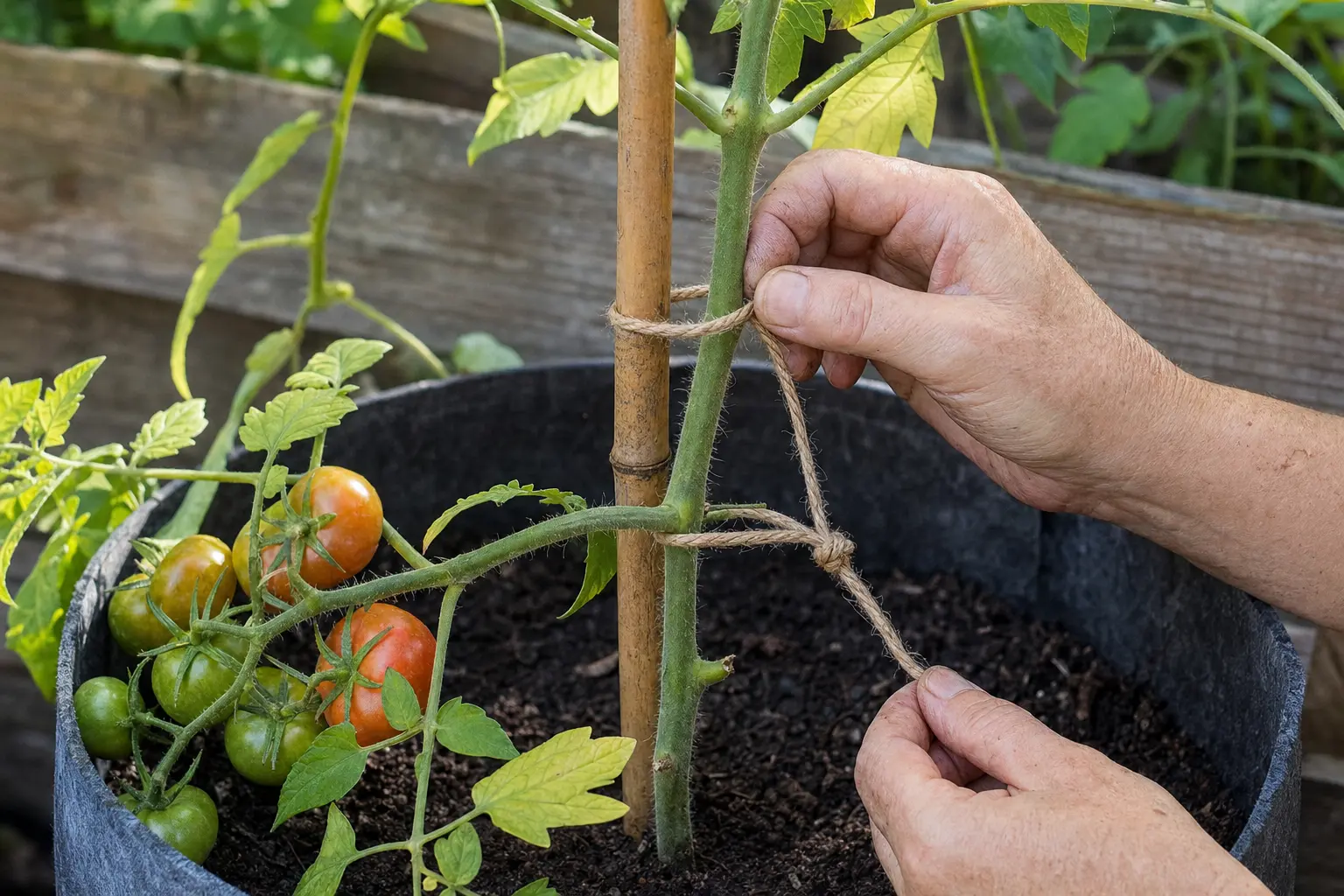
Staking is the classic way to support cordon tomatoes. It works in pots, grow bags, raised beds and open ground, provided the stake is tall and secure enough.
You will need
- A sturdy bamboo cane, wooden stake, metal stake or similar support
- Soft garden twine, cloth strips, tomato clips or flexible plant ties
- A mallet or firm pressure for pushing the stake into soil
- Secateurs for removing side shoots if growing cordons
1. Put the stake in at planting time
Install the stake when you plant the tomato, or very soon afterwards. This avoids damaging the roots later. Place it close enough to support the plant, but not so close that it rubs hard against the stem.
For outdoor plants in soil, push the stake deeply enough that it cannot wobble. In a pot, push the cane to the bottom of the container. If the pot is light, the whole pot may still blow over, so use a heavy container or position it somewhere sheltered.
2. Use a tall enough support
A short cane is a common beginner mistake. Cordon tomatoes can easily reach 1.5–2 m or more in good conditions, and vigorous varieties may keep trying to grow beyond that.
As a rule, choose the tallest practical support before planting. It is much easier to stop a plant at the top later than to rescue a heavy, unsupported tomato in midsummer.
3. Tie the main stem loosely
Tie the main stem to the cane with a soft material. Make a loose loop around the stem and a firmer loop around the cane, or use a figure-of-eight tie so the tie sits between stem and support. This reduces rubbing.
The tie should support the plant without squeezing it. Tomato stems thicken as they grow, so tight ties can cut into the stem and restrict growth.
4. Add more ties as the plant grows
Do not rely on one tie at the bottom. Add a new tie every 20–30 cm or whenever the plant begins to lean away from the support. Tie below a leaf joint or just below a fruit truss where possible, so the plant is supported without crushing flowers or fruit.
Check ties weekly during fast growth. Loosen or replace any that are becoming tight.
5. Keep cordons pruned to fit the support
A single-stem cordon is much easier to support than a plant with several long, heavy side shoots. Remove small side shoots from the joint between the main stem and leaf stalk while they are young.
If you are unsure what to remove, read our full guide on how to prune tomatoes before cutting heavily.
How to use tomato cages
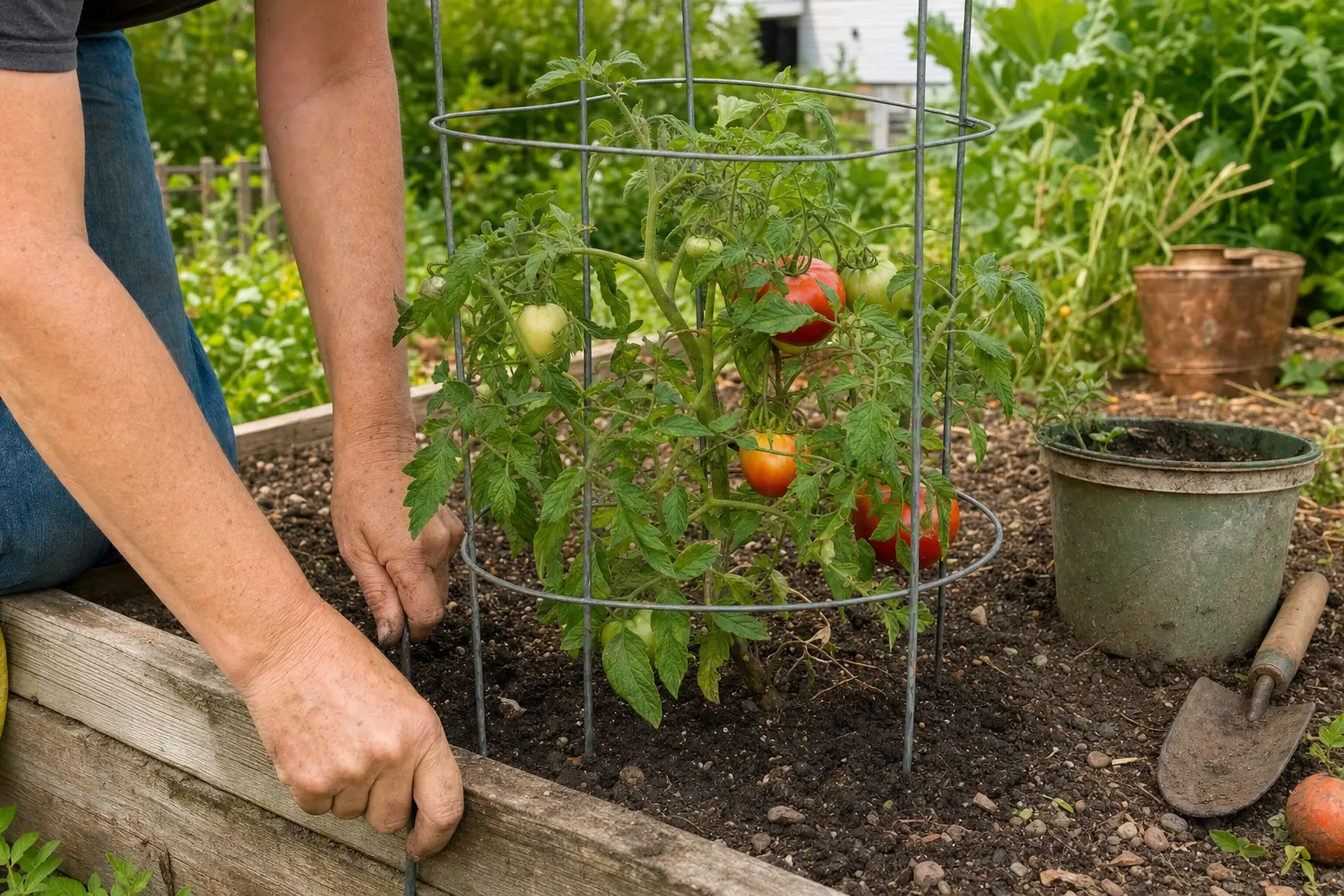
Tomato cages surround the plant and allow stems to lean against the frame rather than being tied to one central cane. They are especially useful for bush tomatoes because they support a wider, branching shape.
Choose a strong cage
Many small cone-shaped cages sold for tomatoes are only suitable for compact patio plants. Larger bush tomatoes and vigorous cherry tomatoes need something wider and stronger.
Look for a cage that is:
- wide enough for the plant’s mature spread
- tall enough to support heavy stems
- made from rigid wire, metal or strong timber
- open enough for your hand to reach fruit without bruising it
- easy to anchor with pegs, canes or stakes
A cage with generous openings is much more practical at harvest time than a tight mesh cage that traps stems and fruit.
Install the cage early
Put the cage around the plant when it is young. Trying to force a cage over a large tomato plant often breaks stems.
Press the cage legs firmly into the soil or compost. Outdoors, add one or two stakes beside the cage and tie the cage to them. This is particularly important in windy gardens or raised beds where the plant will be more exposed.
Guide stems back inside
Caged tomatoes need less tying than staked tomatoes, but they are not completely maintenance-free. As the plant grows, tuck wayward stems gently back inside the cage before they become stiff and brittle.
For bush tomatoes, avoid heavy pruning. The foliage helps shade fruit and supports the plant’s natural cropping habit. Remove damaged, yellowing or soil-touching leaves where needed, but do not strip the plant bare.
How to use a string trellis for cordon tomatoes
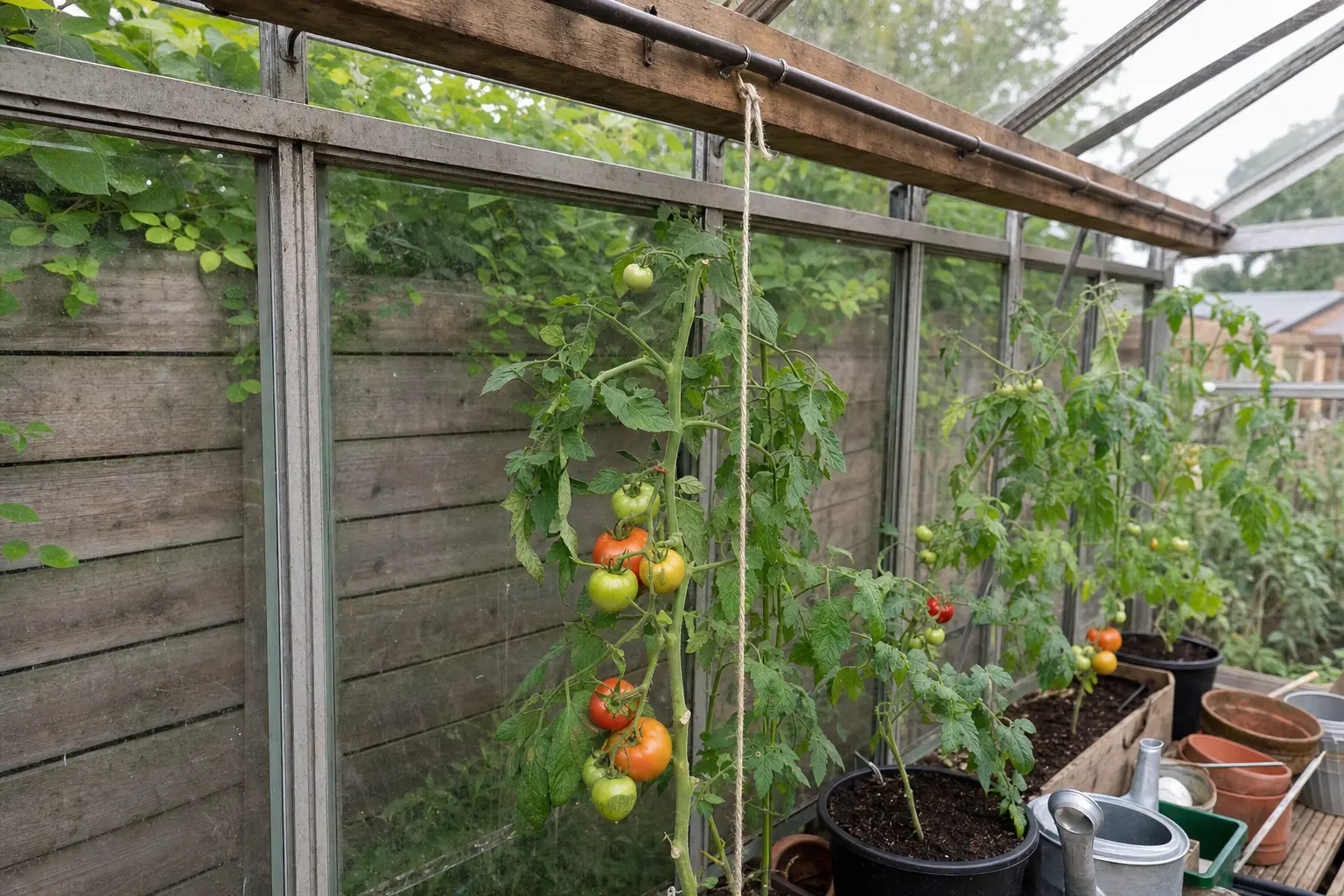
A string trellis is ideal in a greenhouse, polytunnel or very sheltered outdoor bed with a strong overhead frame. Instead of tying the plant to a cane, you train the main stem around a hanging string or attach it with clips.
Set up the top support first
The overhead support must be strong. By late summer, a row of fruiting tomatoes is much heavier than it looks. Do not tie strings to a weak greenhouse vent, thin plastic part or loose wire.
Good fixing points include:
- a sturdy greenhouse crop bar
- a strong timber frame
- a taut horizontal wire fixed to secure posts
- a purpose-built tomato support frame
Fix the string safely
Tie strong twine to the overhead support and let it hang beside the plant. The bottom can be tied loosely around the base of the plant, fixed to a ground peg, or secured beneath the rootball at planting time in some greenhouse systems.
Do not tie a tight knot around the stem. The aim is to support the plant, not strangle it.
Train the plant as it grows
As the cordon grows, gently twist the stem around the string or fasten it with tomato clips. Do this regularly while the growth is soft. If you leave it too long, the stem can bend sharply or snap when you try to correct it.
A string trellis works best with regular side-shoot removal. Otherwise, the plant becomes too heavy and crowded for one string.
How to use a weave system for rows
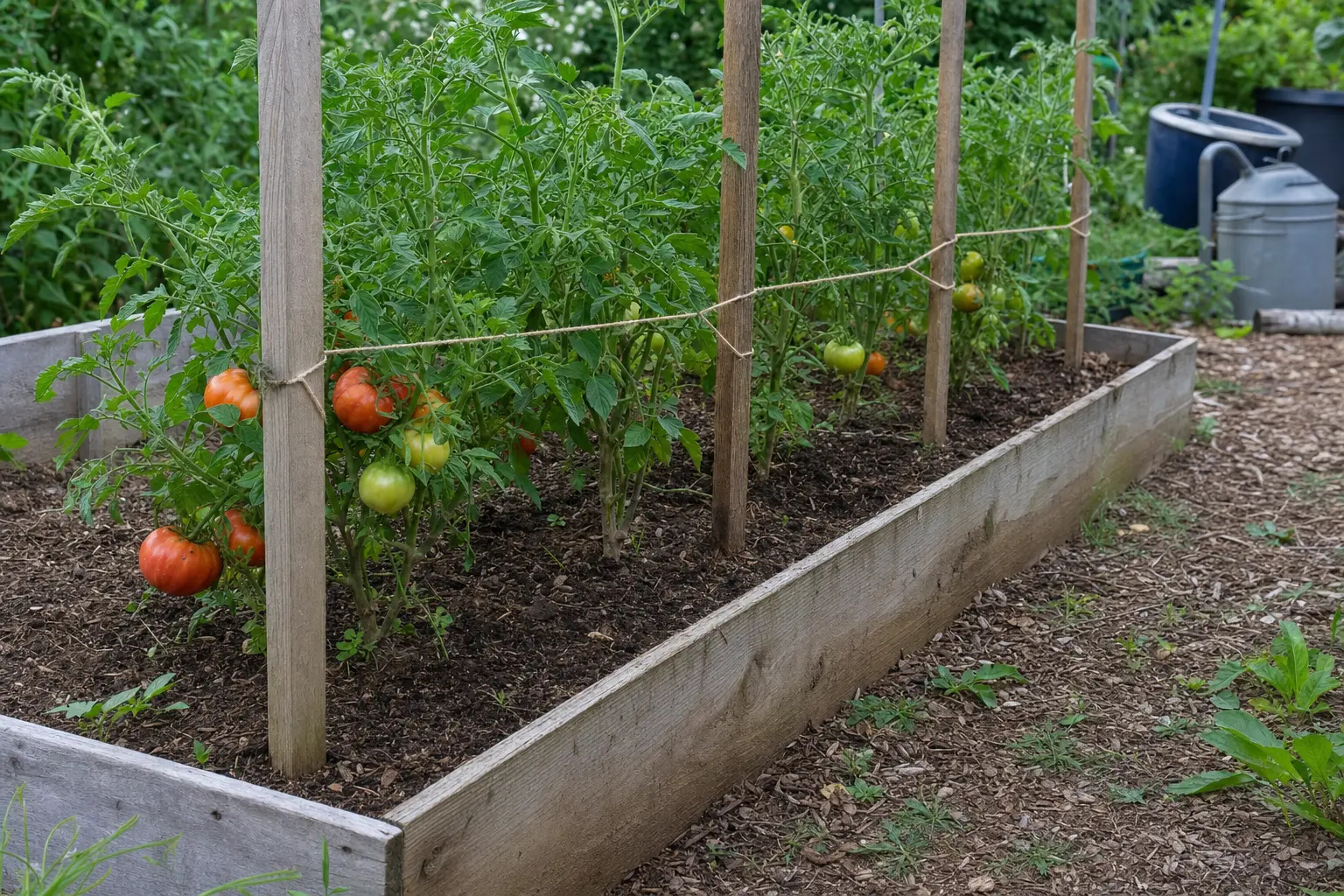
A weave system, often called a Florida weave or basket weave, is useful when you grow several tomato plants in a row. Instead of giving every plant its own full cage, you place stakes along the row and run twine along both sides of the plants to hold them upright.
This method is most useful for tomatoes in the ground or in long raised beds. It is not the best choice for one or two pots on a patio.
Basic weave method
- Plant tomatoes in a straight row with sensible spacing for the variety.
- Drive strong stakes into the soil at the row ends and between plants, or between every other plant.
- When plants are still young, tie twine to the first stake about 20–25 cm above the soil.
- Run the twine along one side of the row, looping it around each stake to keep it taut.
- Return along the other side of the plants, again looping around each stake.
- Add another layer of twine every 15–25 cm of new growth.
The stems are held between the two lines of twine. Keep the twine firm but not so tight that it cuts into stems.
For tall indeterminate tomatoes, use taller stakes and be prepared for more pruning, topping or extra support. For compact bush tomatoes in a row, the weave can be very efficient.
Tying, pruning and ongoing care
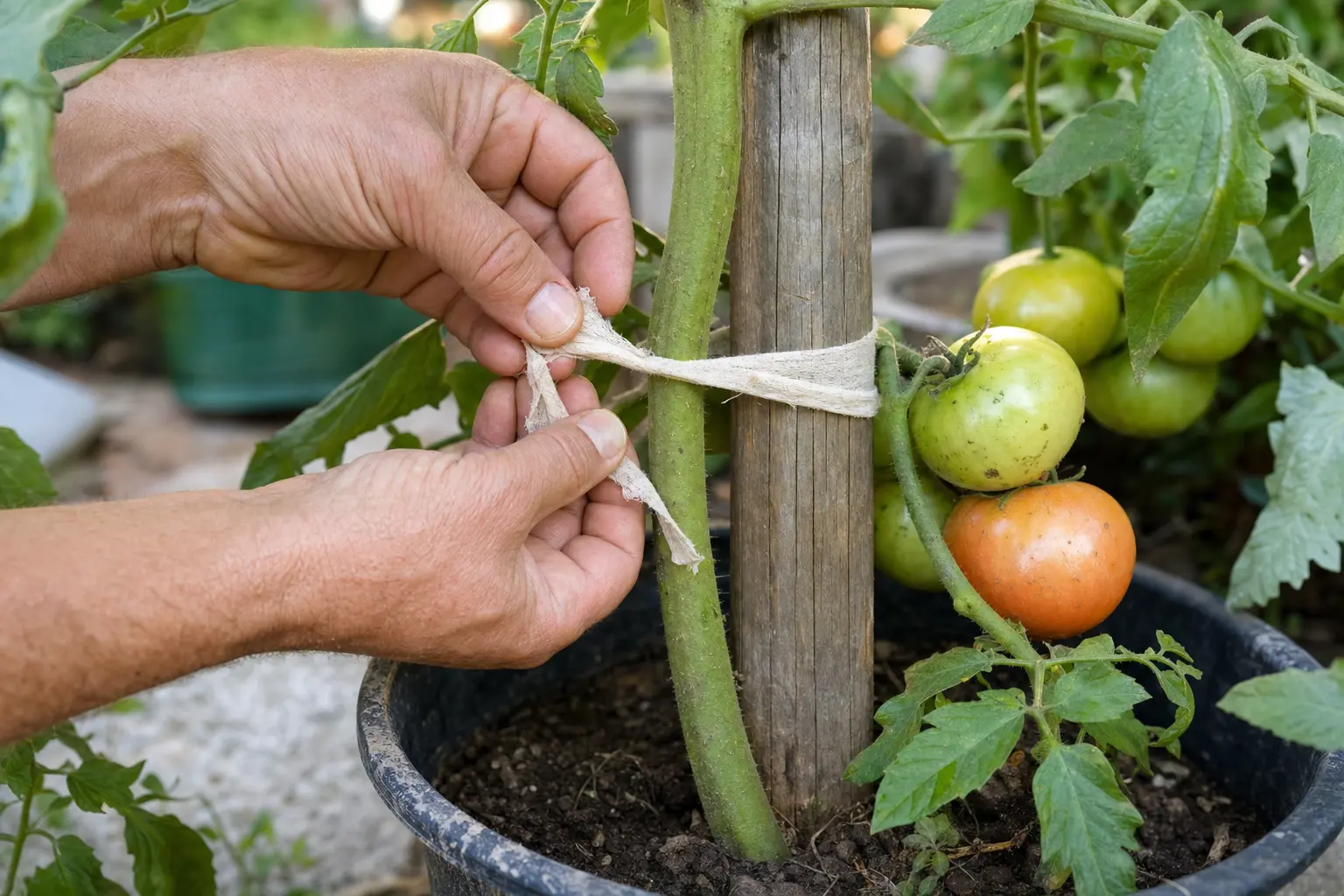
Support systems work best when combined with steady plant care. A tomato plant that is well tied, evenly watered and sensibly pruned is much less likely to collapse.
Use soft ties
Good tying materials include:
- soft garden twine
- strips of old cotton fabric
- flexible rubber plant ties
- purpose-made tomato clips
- soft jute or similar garden string, if it does not cut into stems
Avoid thin wire, fishing line or very narrow plastic ties directly against stems. These can cut in as the plant grows.
Check supports weekly
During warm weather, tomato plants can grow quickly. Once a week, check:
- whether the main stem needs another tie
- whether old ties are too tight
- whether the cane, cage or frame is leaning
- whether heavy fruit trusses need extra support
- whether any stems are rubbing, trapped or kinked
A few minutes of maintenance prevents many midsummer disasters.
Prune according to plant type
Cordon tomatoes normally need side shoots removed. This keeps the plant manageable and directs growth up the support.
Bush tomatoes usually should not be pruned in the same way. Removing too much growth from bush types can reduce cropping and expose fruit to sunscald in hot weather. Limit pruning to damaged, diseased or badly congested growth unless the variety instructions say otherwise.
Keep foliage dry where possible
Supported plants are easier to water at soil level, which helps keep foliage dry. Water the compost or soil around the base rather than spraying the leaves. This is especially helpful in humid greenhouses and wet summers, where damp foliage can encourage disease.
Mulching around outdoor plants can also reduce soil splash.
Supporting tomatoes in pots, raised beds and greenhouses
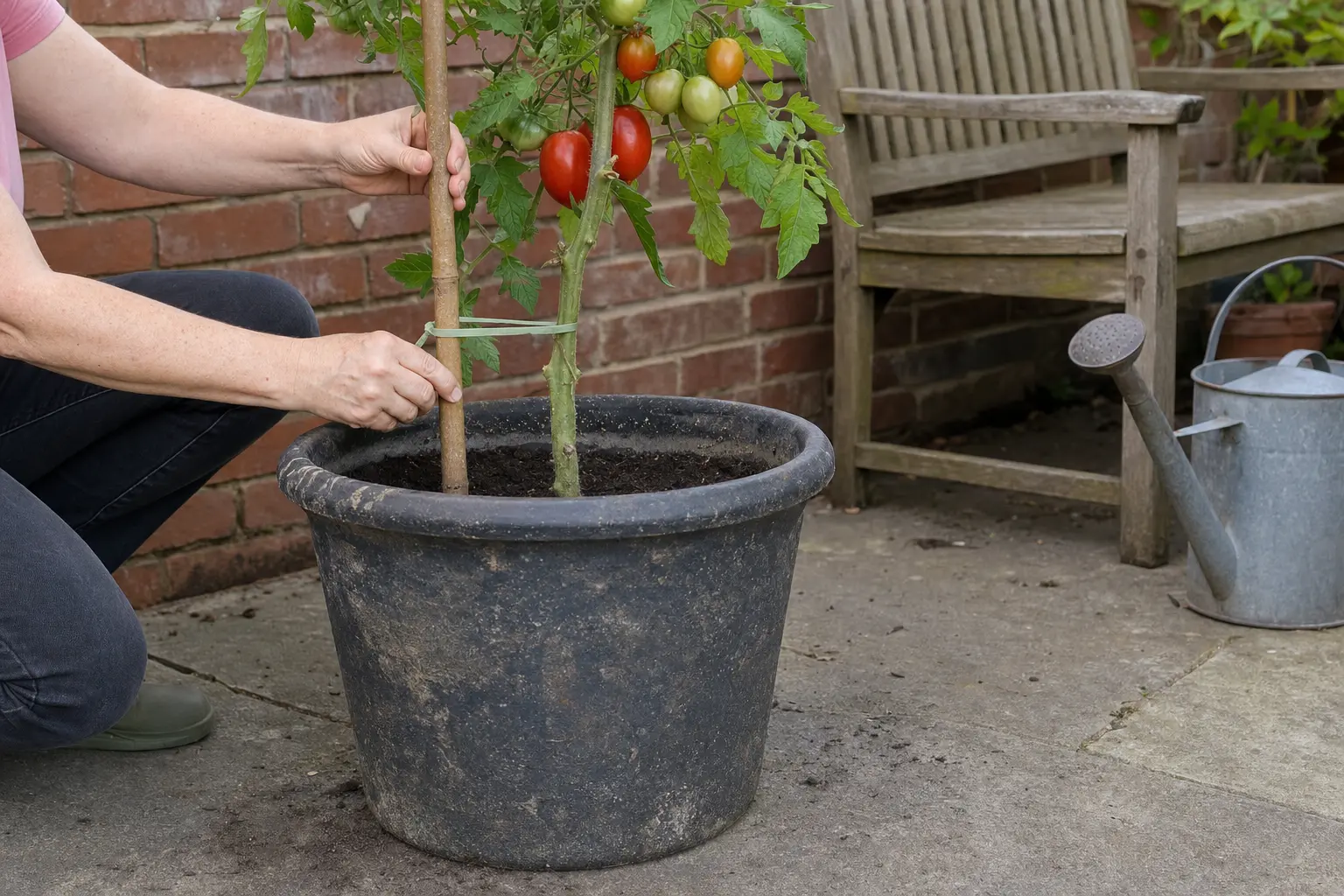
Different growing spaces need slightly different support choices.
Pots and containers
Tomatoes in pots are top-heavy once mature. The support may be strong, but the pot itself can still topple.
For pots:
- choose a large, heavy container
- insert the cane or cage right to the bottom
- use a cage for bush varieties and a tall cane or string for cordons
- place pots against a sheltered wall if wind is a problem
- avoid tiny supports for vigorous varieties
If you are growing a tall cordon in a container, consider tying the cane to a wall hook, balcony rail or greenhouse frame for extra stability, as long as the fixing is safe and secure.
Raised beds
Raised beds are excellent for tomatoes, but supports may need deeper anchoring because the soil can be lighter and the plants more exposed to wind.
Use long stakes, firm posts or cages anchored with additional canes. If your raised bed has a timber frame, you may be able to attach a sturdy trellis or horizontal wire to the bed structure, but make sure it can bear the weight of mature plants.
Greenhouses and polytunnels
Greenhouses are ideal for cordon tomatoes because you can use vertical space. Strings fixed to a secure crop bar or frame keep plants tidy and make harvesting easier.
However, greenhouse tomatoes can grow very vigorously. Keep up with tying, twisting, side-shoot removal and watering. Dense unsupported foliage reduces airflow and makes it harder to spot problems early.
Common mistakes to avoid
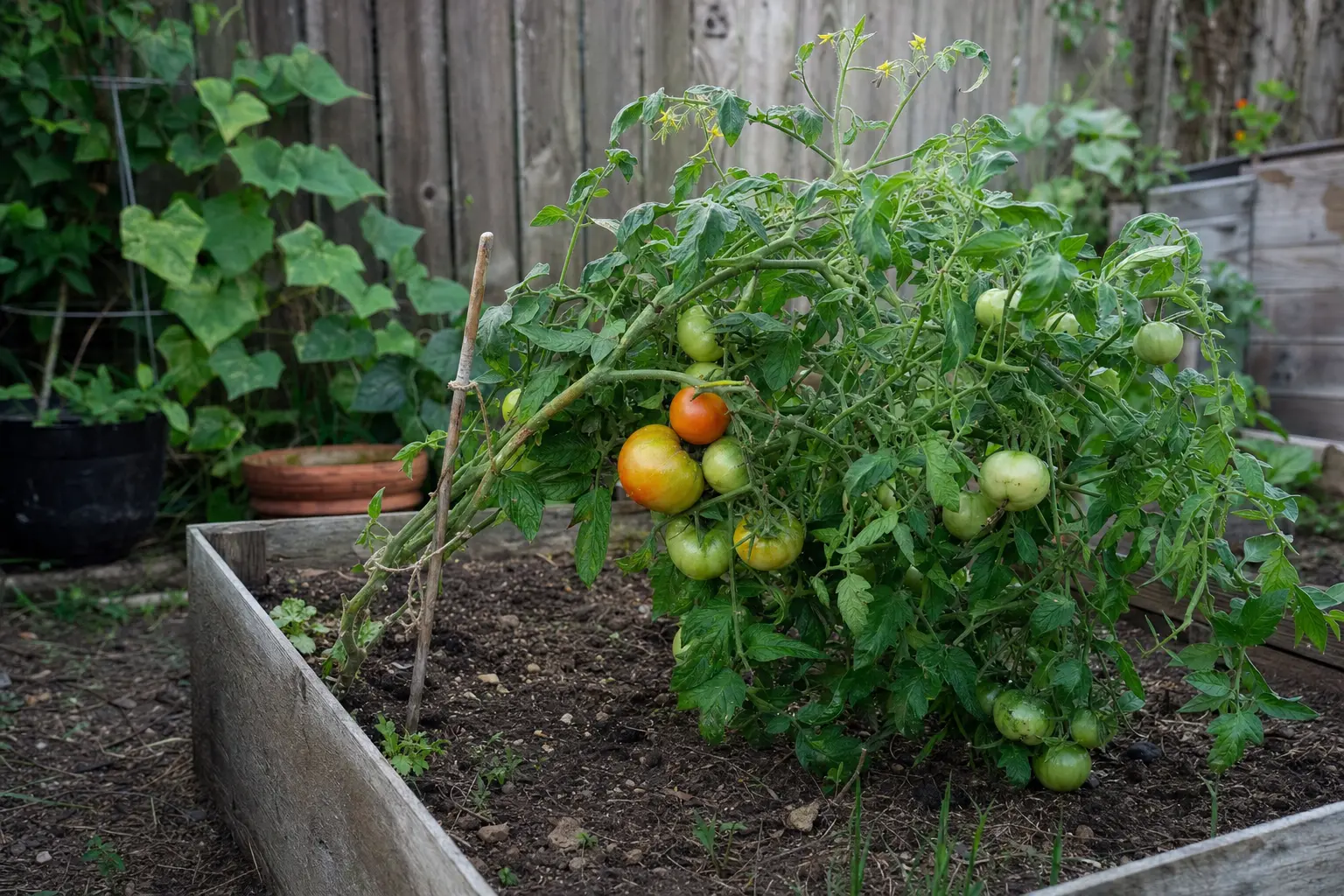
Waiting too long to add support
Install supports at planting time. Adding a stake later can damage roots, and wrestling a cage over a large plant often breaks stems.
Using supports that are too short or flimsy
Tomatoes become heavy. Thin canes, light decorative obelisks and small cone cages may not hold a mature plant in fruit. Choose stronger supports than you think you need.
Tying stems too tightly
Tight ties can cut into tomato stems as they swell. Always leave room for growth and check ties through the season.
Pruning bush tomatoes like cordons
Bush tomatoes fruit on a naturally branching framework. If you remove too many shoots, you may reduce the crop and expose fruit to too much sun.
Letting cordons become multi-stemmed by accident
If cordon side shoots are left to grow, the plant can become too heavy for a single cane or string. Remove small side shoots regularly, or deliberately train an extra stem only if your support is strong enough.
Forgetting about wind
Wind can uproot cages, snap stems and topple pots. Outdoor tomatoes need firm anchoring, especially in exposed gardens, balconies and raised beds.
Making harvesting difficult
A support is not useful if you cannot reach the fruit. Choose cages with large openings and leave enough space between plants for your hands, watering can and harvest basket.
FAQ
Do all tomato plants need support?
Most tomato plants benefit from some support. Cordon tomatoes definitely need it because they grow tall and continue producing up the stem. Bush and patio tomatoes may stand for a while without help, but heavy fruit can still pull stems down, so a cage or short stake is usually worthwhile.
What is the easiest way to support tomato plants?
For beginners, the easiest method is usually a strong cane for each cordon tomato or a sturdy cage for each bush tomato. Put the support in when you plant, then check it weekly.
Are tomato cages better than stakes?
Neither is always better. Cages are easier for bush tomatoes and need less tying. Stakes are better for cordon tomatoes trained as one main stem. A cage supports a wider plant; a stake supports a tall, narrow plant.
Can I use bamboo canes for tomatoes?
Yes, bamboo canes are commonly used for tomatoes, especially cordons. Choose thick, tall canes and push them deeply into the soil or compost. For heavy outdoor plants, a single thin cane may not be enough.
How tall should tomato supports be?
For cordon tomatoes, use a support around 1.5–2 m tall above soil level if possible, and taller for very vigorous varieties or greenhouse crops. Bush tomatoes can use shorter cages or stakes, but the support should still match the mature size of the variety.
How often should I tie tomato plants?
Check plants at least once a week in active growth. Add a new tie whenever the stem begins to lean or every 20–30 cm along a cane. Loosen old ties if they start to pinch the stem.
Can I support tomato plants after they have grown large?
You can, but it is harder and riskier. Add support as gently as possible, working with another person if the plant is heavy. Use several soft ties rather than forcing the stem into a new position all at once.
What should I use for tomatoes in grow bags?
Grow bags need careful support because they are shallow. Use a grow bag frame, canes fixed to a stable support, or strings tied to a secure overhead greenhouse bar. A cane pushed only into the grow bag may not be stable enough for a heavy cordon plant.
Final thoughts
The best way to support tomato plants is to match the support to the plant’s growth habit. Train cordon tomatoes up a tall cane, stake or string. Give bush tomatoes a cage or frame that supports their branching shape. For rows, consider a weave system.
Whichever method you choose, start early, use soft ties, check plants weekly and plan for the weight of a fully grown tomato loaded with fruit. A strong support system makes the whole season easier, from watering and pruning to picking ripe tomatoes without broken stems or muddy fruit.